


Page 25 - (DK Eyewitness) Travel Guide - Sydney
P. 25
THE HIST OR Y OF SY DNEY 23
Where to See Aboriginal
Rock Art and Artifacts
The soft sandstone of Sydney
Ku-ring-gai
is named after Hunting and Fishing Implements was a natural canvas. Much of the
clans who lived Multipronged Eora spears were used for fishing, rock art of the original inhabitants
in this coastal while canoes were shaped from a single piece of remains and can be found on
dis trict. It is rich in bark. Boomerangs, with their angled shape and walking trails in Kuringgai Chase
rock engravings. asymmetrical curves, made for highly effective National Park (see pp156–7) and
hunting weapons. in the Royal National Park (p167).
The NSW Office of Environment
and Heritage has information on
a number of Aboriginal sites
(www.environment.nsw.gov.au/
nswcultureheritage/RockArt.htm).
Berowra
Waters
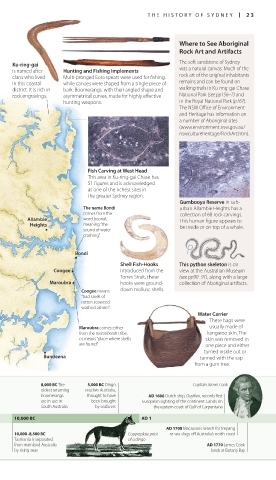
Fish Carving at West Head
This area in Kuringgai Chase has
51 figures and is acknow ledged
as one of the richest sites in
the greater Sydney region.
Gumbooya Reserve in sub
The name Bondi urban Allambie Heights has a
comes from the collection of 68 rock carvings.
Allambie word boondi, This human figure appears to
Heights meaning “the be inside or on top of a whale.
sound of water
crashing”.
Bondi
Shell Fish-Hooks This python skeleton is on
Coogee Introduced from the view at the Australian Museum
Torres Strait, these (see pp90–91), along with a large
Maroubra hooks were ground collection of Aboriginal artifacts.
Coogee means down mollusc shells.
“bad smell of
rotten seaweed
washed ashore”.
Water Carrier
These bags were
Maroubra comes either usually made of
from the merooberah tribe, kangaroo skin. The
or means “place where shells skin was removed in
are found”. one piece and either
turned inside out or
Bundeena tanned with the sap
from a gum tree.
11,000 Burial site 8,000 BC The 5,000 BC Dingo Captain James Cook
excavated in oldest returning reaches Australia,
Victoria of more boomerangs thought to have AD 1606 Dutch ship, Duyfken, records first
than 40 individuals are in use in been brought European sighting of the continent. Lands on
of this period South Australia by seafarers the eastern coast of Gulf of Carpentaria
10,000 BC AD 1
AD 1700 Macassans search for trepang
10,000–8,500 BC Copperplate print or sea slugs off Australia’s north coast
Tasmania is separated of a dingo
from mainland Australia AD 1770 James Cook
by rising seas lands at Botany Bay
022-023_EW_Sydney.indd 23 29/05/17 12:18 pm

