


Page 88 - (DK Eyewitness) Travel Guide - Sydney
P. 88
86 SY DNEY AREA B Y AREA
5 Strand Arcade
412–414 George St. Map 1 B5.
Tel 9265 6800. Martin Place,
Wynyard. Open 9am–5:30pm Mon–
Wed & Fri, 9am–9pm Thu, 9am–8pm
Sat, 11am–4pm Sun. Closed some
public hols, 25 & 26 Dec. 7 See Shops
and Markets: pp198–201.
Victorian Sydney was a city of
grand shopping arcades. The
Strand, joining George and Pitt
Streets and designed by English
architect John Spencer, was the
finest jewel in the city’s crown.
The blaze of publicity surrounding
its opening in April 1892 was
equalled only by the natural
light pouring through the glass
roof and the artificial glare from
the chan deliers, each carrying
50 jets of gas as well as 50 lamps.
The boutiques and shops in
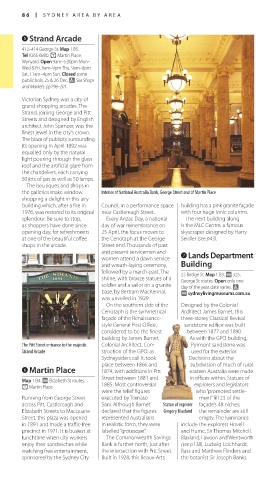
the galleries make window Interior of National Australia Bank, George Street end of Martin Place
shopping a delight in this airy
building which, after a fire in Council, in a performance space building has a pink granite façade
1976, was restored to its origi nal near Castlereagh Street. with four huge Ionic columns.
splendour. Be sure to stop, Every Anzac Day, a national The next building along
as shoppers have done since day of war remembrance on is the MLC Centre, a famous
opening day, for refreshments 25 April, the focus moves to skyscraper designed by Harry
at one of the beautiful coffee the Cenotaph at the George Seidler (see p43).
shops in the arcade. Street end. Thou sands of past
and present service men and 7 Lands Department
women attend a dawn service
and wreath-laying cere mony, Building
followed by a march-past. The 23 Bridge St. Map 1 B3. @ 325,
shrine, with bronze statues of a George St routes. Open only one
soldier and a sailor on a granite day of the year, date varies. 7
base, by Bertram MacKennal, ∑ sydneylivingmuseums.com.au
was unveiled in 1929.
On the southern side of the Designed by the Colonial
Cenotaph is the symmetrical Architect James Barnet, this
façade of the Renaissance- three-storey Classical Revival
style General Post Office, sandstone edifice was built
consid ered to be the finest between 1877 and 1890.
building by James Barnet, As with the GPO building,
The Pitt Street entrance to the majestic Colonial Architect. Con- Pyrmont sandstone was
Strand Arcade struction of the GPO, as used for the exterior.
Sydneysiders call it, took Decisions about the
place between 1866 and sub division of much of rural
6 Martin Place 1874, with additions in Pitt eastern Australia were made
Street between 1881 and in offices within. Statues of
Map 1 B4. @ Elizabeth St routes.
Martin Place. 1885. Most contro versial explorers and legislators
were the relief figures who “pro moted settle-
Running from George Street exe cuted by Tomaso ment” fill 23 of the
across Pitt, Castlereagh and Sani. Although Barnet Statue of explorer façade’s 48 niches;
Elizabeth Streets to Macquarie declared that the figures Gregory Blaxland the remainder are still
Street, this plaza was opened represented Australians empty. The luminaries
in 1891 and made a traffic-free in realistic form, they were include the explorers Hovell
precinct in 1971. It is busiest at labelled “grotesque”. and Hume, Sir Thomas Mitchell,
lunchtime when city workers The Commonwealth Savings Blaxland, Lawson and Wentworth
enjoy their sandwiches while Bank is further north, just after (see p138), Ludwig Leichhardt,
watching free entertainment, the intersection with Pitt Street. Bass and Matthew Flinders and
sponsored by the Sydney City Built in 1928, this Beaux-Arts the botanist Sir Joseph Banks.
086-087_EW_Sydney.indd 86 29/05/17 12:19 pm

