


Page 120 - How It Works - Book Of Amazing Answers To Curious Questions, Volume 05-15
P. 120
What is the future                                                              Building better


         of       commuting?                                                             buses
                                                                                         Bus rapid transit, or BRT, is billed as the future of
                                                                                         urban transport. The system aims to efficiently
                                                                                         ferry passengers around busy urban
                                                                                         environments in a cost-effective way, and BRT
         Explore the cutting-edge technology set                                         vehicles travel on dedicated bus-only lanes that
                                                                                         are segregated from regular vehicle carriageways,
                                                                                         reducing delays due to traffic. All bus stop
         to change the way we travel                                                     platforms are at the same height as the floor of the
                                                                                         bus for easy access for wheelchair and pram users,
                                                                                         and passengers pre-pay for the bus electronically;
               ow long do you spend commuting every   including motorbikes, buses and even helicopters.   significantly reducing the amount of time a bus
               day? The average journey time is a   This means we’ll be producing fewer emissions   remains stationary at stops. This means BRT can
         Hsoul-sucking 60 minutes, which amounts   on our journey to work and we won’t be relying on   provide a speedier service, ensuring commuters
                                                                                         spend less time in the place they don’t want to be
         to over a year of our lives travelling to and from   the Earth’s diminishing supply of oil to power our   – the bus.
         work. Whether it’s via road, train or even sky, the   various forms of transport. In fact, some forms of
         commuter experience is blighted by traffi c and   transport are likely to produce more energy than      Signal priority
         human or technological errors, leading to delays   they actually use!                             Some rapid bus systems use
         and expensive fares to supplement archaic modes   Of course, electricity isn’t the only source    signal priority transmitters
                                                                                                             to hold a green light long
         of transport.                          powering commuter vehicles both now and in the               enough for the bus to get
           However, the daily slog could be about to   future. Innovative forms of travel include linear     through an intersection.
         change for the better. Thanks to a raft of new   electric motors for Elon Musk’s Hyperloop and
         technology, we’ll see vast improvements to the   maglev technology for Israel’s skyTran. We also
         speed and safety of a commute over the next 50 to   can’t forget the ‘number two’ Bio-Bus in the UK
         100 years, through improving current transit   that’s currently transporting passengers between
         systems and implementing entirely new modes of   the cities of Bath and Bristol, thanks to the
         transport in the future. These range from faster,   biomethane gas produced from human waste!
         more efficient bus services, to sophisticated   No matter what way you look at it, the

         capsule-based transport that will turn a three-  international workforce of the future has little to
         hour journey into a thirty-minute intercity blast.  fear. They’ll be able to relax, sipping coffee as
           The future of commuting will also benefi t the   their autonomous car does all the steering, or
         environment thanks to the development of   reclining in a levitating pod that soars above the
         cleaner, greener vehicles. Electric and hybrid   city. Over the next few pages, take a glimpse into
         engines are an increasingly popular choice in   the exciting future of travel but in the meantime,
         passenger cars, and the technology is   always remember to mind the gap between the
         transcending into other forms of transport   train and platform edge!


           New and

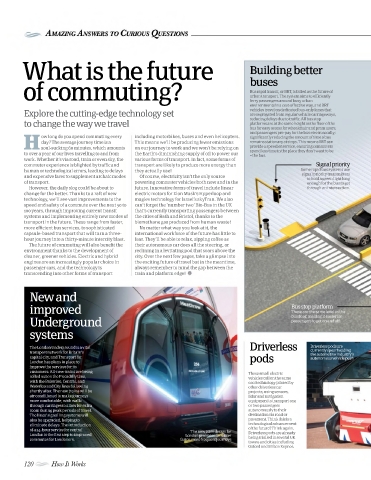
           improved                                                                                    Bus stop platform
                                                                                                       These are the same level as the
                                                                                                       bus floor, making it easier for

           Underground                                                                                 passengers to get on and off.
           systems


           The London Underground is a vital                                             Driverless           Driverless pods are
           transport network for Britain’s                                                                    currently spearheading
                                                                                                              the automotive industry’s
           capital city, and Transport for                                               pods                 autonomous vehicle push
           London has plans in place to
           improve the services for its
           customers. All-new trains are being                                          These small electric
           rolled out on the Piccadilly Line,                                           vehicles call on the same
           with the Bakerloo, Central, and                                              cool technology piloted by
           Waterloo and City lines following                                            other driverless car
           shortly after. The new trains will be                                        projects, using sensors,
           air conditioned to make journeys                                             lidar and navigation
           more comfortable, with walk-                                                 equipment to transport one
           through carriages to allow for extra                                         or two passengers
           room during peak periods of travel.                                          autonomously to their
           The lines’ signalling systems will                                           destination via road or
           also be upgraded, helping to                                                 pavement. Think this is a
           eliminate delays. The introduction                                           technological advancement
           of a 24-hour service for central                         The new train design for   of the future? Think again.
           London is the first step to improved                    London promises to deliver   Driverless pods are already

           commutes for Londoners.                              faster, more frequent journeys  being trialled in several UK
                                                                                        towns and cities including
                                                                                        Oxford and Milton Keynes.
          120       How It Works

