


Page 116 - How It Works - Book Of Amazing Answers To Curious Questions, Volume 05-15
P. 116
How long
             Why can we see the Moon                                                   could a

             in the daytime?
                                                                                       stranded

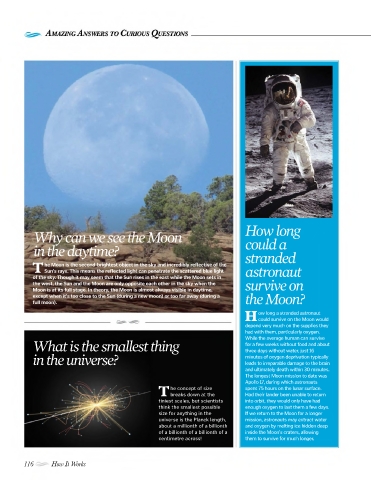
                 he Moon is the second-brightest object in the sky and incredibly reflective of the

            T Sun’s rays. This means the refl ected light can penetrate the scattered blue light   astronaut
             of the sky. Though it may seem that the Sun rises in the east while the Moon sets in
             the west, the Sun and the Moon are only opposite each other in the sky when the   survive on
             Moon is at its full stage. In theory, the Moon is almost always visible in daytime,
             except when it’s too close to the Sun (during a new moon) or too far away (during a   the Moon?
             full moon).
                                                                                            ow long a stranded astronaut
                                                                                       H could survive on the Moon would
                                                                                       depend very much on the supplies they
                                                                                       had with them, particularly oxygen.
                                                                                       While the average human can survive
             What is the smallest thing                                                for a few weeks without food and about
                                                                                       three days without water, just 16
             in the universe?                                                          minutes of oxygen deprivation typically
                                                                                       leads to irreparable damage to the brain
                                                                                       and ultimately death within 30 minutes.
                                                                                       The longest Moon mission to date was
                                                                                       Apollo 17, during which astronauts
                                                             he concept of size        spent 75 hours on the lunar surface.
                                                         T breaks down at the          Had their lander been unable to return
                                                         tiniest scales, but scientists   into orbit, they would only have had
                                                         think the smallest possible   enough oxygen to last them a few days.
                                                         size for anything in the      If we return to the Moon for a longer
                                                         universe is the Planck length,   mission, astronauts may extract water
                                                         about a millionth of a billionth   and oxygen by melting ice hidden deep
                                                         of a billionth of a billionth of a   inside the Moon’s craters, allowing
                                                         centimetre across!            them to survive for much longer.


          116       How It Works

