


Page 47 - How It Works - Book Of Amazing Answers To Curious Questions, Volume 05-15
P. 47
Technology


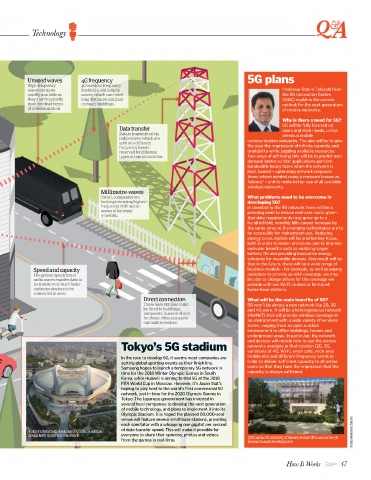
           Unused waves       4G frequency                                              5G plans
           High-frequency     4G uses low-frequency
           waves are more     800MHz-2.6GHz radio                                                   Professor Rahim Tafazolli from
           readily available as   waves, which can travel                                           the 5G Innovation Centre
           they aren’t typically   long distances and pass                                          (5GIC) explains the current
           used for other forms   through buildings.                                                outlook for the next generation
           of communication.                                                                        of mobile networks.

                                                                                                    Why is there a need for 5G?
                                                                                                    5G will be fully focused on
                                           Data transfer                                            users and their needs, unlike
                                           Data is transmitted via                                  previous mobile
                                           radio waves, which are                       communication networks. The aim will be to give
                                           split into different

                                           frequency bands                              the user the impression of infinite capacity and
                                           reserved for different                       availability while juggling available resources.
                                           types of communication.                      Two ways of achieving this will be to predict user
                                                                                        demand better so that applications perform
                                                                                        bandwidth-heavy tasks when the network is
                                                                                        least loaded – optimising network response
                                                                                        times where needed using a measure known as
                                                                                        ‘latency’ – and to make better use of all available
                                                                                        wireless networks.
                                     Millimetre-waves
                                     For 5G, companies are                              What problems need to be overcome in
                                     looking into using higher-                         developing 5G?
                                     frequency millimetre-                              In developing the 5G network there will be a
                                     waves at between                                   pressing need to reduce end-user costs: given
                                     3-300GHz.
                                                                                        that data requirements may grow up to a
                                                                                        hundred-fold, monthly bills cannot increase by
                                                                                        the same amount if emerging technologies are to
                                                                                        be accessible for mainstream use. Reducing
                                                                                        energy consumption will be another key focus,
                                                                                        both in order to lessen emissions and to improve

                                                                                        end-user benefits such as enabling longer
                                                                                        battery life and providing innovative energy
                                                                                        solutions for wearable devices. One result will be
                                                                                        that in the future, there will be a wide range of
             Speed and capacity                                                         business models – for example, as well as paying
             The greater spectrum of                                                    operators to provide us with coverage, we may
             radio waves enables data to                                                be able to charge others for the coverage we
             be transferred much faster                                                 provide with our Wi-Fi routers or femtocell
             and more devices to be                                                     home-base stations.
             connected at once.
                                                   Direct connection                    What will be the main benefits of 5G?

                                                   These base stations could            5G won’t be simply a new network like 2G, 3G
                                                   be fitted to buildings,               and 4G were. It will be a heterogeneous network

                                                   lampposts, buses and cars            (HetNeT) that will provide wireless coverage in
                                                   for closer, direct access to         an environment with a wide variety of wireless
                                                   our mobile devices.
                                                                                        zones, ranging from an open outdoor

                                                                                        environment to office buildings, homes and
                                                                                        underground areas. In particular, the network
                                                                                        and devices will decide how to use the access
                                            Tokyo’s 5G stadium                          networks available in that location (2G, 3G,
                                                                                        variations of 4G, Wi-Fi, small cells, wide-area
                                            In the race to develop 5G, it seems most companies are   mobile etc) and different frequency bands in

                                            setting global sporting events as their fi nish line.   order to deliver sufficient capacity to all active
                                            Samsung hopes to launch a temporary 5G network in   users so that they have the impression that the
                                            time for the 2018 Winter Olympic Games in South   capacity is always suffi cient.
                                            Korea, while Huawei is aiming to trial 5G at the 2018
                                            FIFA World Cup in Moscow. However, it’s Japan that’s
                                            hoping to play host to the world’s first commercial 5G

                                            network, just in time for the 2020 Olympic Games in
                                            Tokyo. The Japanese government has invested in
                                            several local companies to develop the next generation
                                            of mobile technology, and plans to implement it into its
                                            Olympic Stadium. It is hoped the planned 80,000-seat
                                            venue will feature several small base stations, providing
                                            each spectator with a whopping one gigabit per second
           Tokyo’s futuristic-looking Olympic Stadium   of data-transfer speed. This will make it possible for               © Zaha Hadid Architects
           could host its own 5G network    everyone to share their opinions, photos and videos   5GIC at the University of Surrey is the UK’s centre for 5G
                                            from the games in real-time.                research and development

                                                                                                      How It Works        47

