


Page 49 - How It Works - Book Of Amazing Answers To Curious Questions, Volume 05-15
P. 49
Technology


            What is inductive


            wireless charging?                                                        How to rid our homes of

                                                                                      messy plugs and cables


                f you have ever had to wrestle with a messy   electronics could be made small enough to make   your device takes longer to charge. It also
                tangle of cables, then the introduction of   wireless charging feasible for devices such as   requires your device to be very close to the

            I wireless phone charging will come as a   artificial hearts and electric toothbrushes.   charger to work, so it effectively still tethers it to
            welcome relief – but this useful technology isn’t   These days, the inductive charging method   a power source just like a cable charger.
            actually all that new. Physicist Nikola Tesla fi rst   can be used for smartphones, tablets and even   However, this could change with a new
            concluded that you could transfer power   electric cars, but if it’s so convenient, why aren’t   method called inductive wireless charging that
            between two objects via an electromagnetic fi eld   we using it all the time? One reason is that it isn’t   is in development and will enable power to be
            in the late 1800s, and by the 1990s wires and   very efficient, as a lot of energy is lost as heat – so   transferred over greater distances.

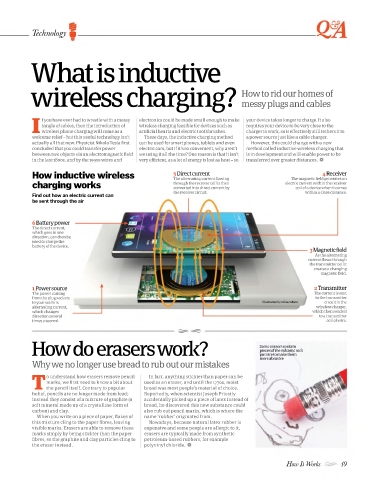
                                                                                                                  4 Receiver
            How inductive wireless                            5 Direct current                         The magnetic field generates an
                                                              The alternating current fl owing

            charging works                                    through the receiver coil is then      electric current within the receiver
                                                                                                         coil of a device when it comes
                                                              converted into direct current by
                                                              the receiver circuit.                         within a close distance.
            Find out how an electric current can
            be sent through the air
            6 Battery power
            The direct current,
            which goes in one
            direction, can then be
            used to charge the
            battery of the device.
                                                                                                              3 Magnetic field
                                                                                                                As the alternating
                                                                                                             current fl ows through
                                                                                                              the transmitter coil it
                                                                                                               creates a changing
                                                                                                                  magnetic fi eld.

            1 Power source                                                                                     2 Transmitter
            The power coming                                                                                   The current is sent
            from the plug sockets                                                                               to the transmitter
            in your walls is                                                                 Illustration by Adrian Mann  circuit in the
            alternating current,                                                                                wireless charger,
            which changes                                                                                      which then sends it
            direction several                                                                                    to a transmitter
            times a second.                                                                                         coil of wire.


            How do erasers work?                                                            Some erasers contain
                                                                                            pieces of the volcanic rock
                                                                                            pumice to make them
                                                                                            more abrasive
            Why we no longer use bread to rub out our mistakes

                 o understand how erasers remove pencil   In fact, anything stickier than paper can be
                 marks, we first need to know a bit about   used as an eraser, and until the 1770s, moist

            Tthe pencil itself. Contrary to popular   bread was most people’s material of choice.
            belief, pencils are no longer made from lead;   Reportedly, when scientist Joseph Priestly
            instead they consist of a mixture of graphite (a   accidentally picked up a piece of latex instead of
            soft mineral made up of a crystalline form of   bread, he discovered this new substance could
            carbon) and clay.                       also rub out pencil marks, which is where the
              When you write on a piece of paper, fl akes of   name ‘rubber’ originated from.
            this mixture cling to the paper fi bres, leaving   Nowadays, because natural latex rubber is
            visible marks. Erasers are able to remove these   expensive and some people are allergic to it,
            marks simply by being stickier than the paper   erasers are typically made from synthetic

            fibres, so the graphite and clay particles cling to   petroleum-based rubbers, for example
            the eraser instead.                     polyvinyl chloride.

                                                                                                      How It Works        49

