


Page 76 - How It Works - Book Of Amazing Answers To Curious Questions, Volume 05-15
P. 76
What is saliva?


         Find out this frothy liquid’s
         vital role in maintaining

         human health

                umans can produce an incredible two
                litres (half a gallon) of saliva each day. It
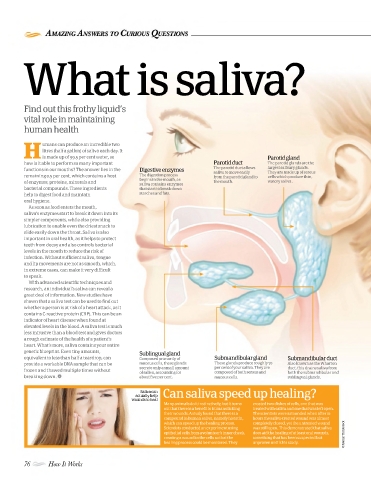
         His made up of 99.5 per cent water, so                                                Parotid gland
         how is it able to perform so many important                        Parotid duct       The parotid glands are the
         functions in our mouths? The answer lies in the   Digestive enzymes  The parotid duct allows   largest salivary glands.
                                                                            saliva to move easily
                                                                                               They are made up of serous
         remaining 0.5 per cent, which contains a host   The digestion process   from the parotid gland to   cells which produce thin,
                                                  begins in the mouth, as
         of enzymes, proteins, minerals and                                 the mouth.         watery saliva.
                                                  saliva contains enzymes
         bacterial compounds. These ingredients   that start to break down
         help to digest food and maintain         starches and fats.
         oral hygiene.
           As soon as food enters the mouth,
         saliva’s enzymes start to break it down into its
         simpler components, while also providing
         lubrication to enable even the driest snack to
         slide easily down the throat. Saliva is also
         important in oral health, as it helps to protect
         teeth from decay and also controls bacterial
         levels in the mouth to reduce the risk of
         infection. Without sufficient saliva, tongue

         and lip movements are not as smooth, which,
         in extreme cases, can make it very diffi cult
         to speak.

           With advanced scientific techniques and
         research, an individual’s saliva can reveal a
         great deal of information. New studies have
         shown that a saliva test can be used to fi nd out
         whether a person is at risk of a heart attack, as it
         contains C-reactive protein (CRP). This can be an
         indicator of heart disease when found at
         elevated levels in the blood. A saliva test is much
         less intrusive than a blood test and gives doctors
         a rough estimate of the health of a patient’s
         heart. What’s more, saliva contains your entire
         genetic blueprint. Even tiny amounts,    Sublingual gland
         equivalent to less than half a teardrop, can   Composed primarily of   Submandibular gland   Submandibular duct
         provide a workable DNA sample that can be   mucous cells, these glands   These glands produce roughly 70   Also known as the Wharton
                                                  secrete only a small amount   per cent of your saliva. They are   duct, this drains saliva from
         frozen and thawed multiple times without
                                                  of saliva, accounting for   composed of both serous and   both the submandibular and
         breaking down.                           about five per cent.       mucous cells.             sublingual glands.

                                                  Saliva can   Can saliva speed up healing?
                                                 actually help
                                               wounds to heal
                                                           Many animals do it instinctively, but it turns   created two dishes of cells, one that was

                                                           out that there is a benefit to humans licking   treated with saliva and one that was left open.
                                                           their wounds. A study found that there is a   The scientists were astounded when after 16
                                                           compound in human saliva, namely histatin,   hours the saliva-treated wound was almost
                                                           which can speed up the healing process.   completely closed, yet the untreated wound
                                                           Scientists conducted an experiment using   was still open. This demonstrated that saliva
                                                           epithelial cells from a volunteer’s inner cheek,   does aid the healing of at least oral wounds,   © Alamy; Thinkstock
                                                           creating a wound in the cells so that the   something that has been suspected but
                                                           healing process could be monitored. They   unproven until this study.


          76       How It Works

