


Page 75 - How It Works - Book Of Amazing Answers To Curious Questions, Volume 05-15
P. 75
Science


            What are the physics


            of the cricket ball?


            In a game of fine margins, physics can make

            all the difference                                                             The mystery of
                                                                                           reverse swing
                 he movement of a cricket ball is unique   revolutions on the ball to allow it to spin

                 within the sporting world. When the ball   fiercely once it has pitched. Slow spin works   Reverse swing, where the ball swings in
            Tis delivered, a layer of air known as a   better on dry and dusty pitches where the ball   the opposite direction to the conventional
            ‘boundary layer’ forms over the ball. This is   can skip off the pitch.        way, is a rare delivery that can dismiss
            where the physics come into play. By angling   Side forces also act on the ball in swing   even the most experienced batsmen. Made
            the seam – the stitched part in the middle – the   bowling. When one side of the ball becomes   famous by the likes of Wasim Akram and
            bowler can alter the pressure of the forces on   rougher than the other, that half becomes less   Imran Khan, the cricket ball can become
                                                                                           almost unplayable. Readily achievable at
            the ball and choose which way the delivery   streamlined. Bowlers frequently use this to   bowling speeds of over 135 kilometres (84
            will go. The aerodynamics can be varied   their advantage to move the ball sideways in   miles) per hour, reverse swing works best
            further by the bowler changing the pace of the   the air in order to confuse batsmen into   when the ball is old and rough. Now the
            ball and where the ball bounces. These   playing false and poorly timed shots. The effect   ball is not shiny so it will move in the
            deliveries are known as ‘cutters’ to cricket fans   of swing can be exaggerated even further by   opposite way to what is expected from a
            and the practice is called seam bowling. Spin is   shining one side of the ball, although using   conventional swing. The boundary layer is
            another weapon in the bowler’s armoury. Spin   anything other than your cricket whites to   affected quicker, allowing an in-swinging
            bowlers use their wrist or fingers to put   rough the ball up is considered unsporting.   bowler to bowl out-swinging deliveries and

                                                                                           vice-versa. As the bowler doesn’t change
                                                                                           his grip, there is no hint to the batsman
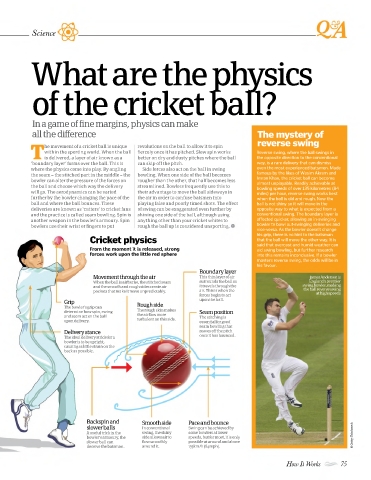
                                 Cricket physics                                           that the ball will move the other way. It is
                                                                                           said that overcast and humid weather can
                                 From the moment it is released, strong                    aid swing bowling, but further research
                                 forces work upon the little red sphere                    into this remains inconclusive. If a bowler
                                                                                           masters reverse swing, the odds will be in
                                                                                           his favour.
                                                                       Boundary layer
                                  Movement through the air             This thin layer of air                 James Anderson is
                                  When the ball is airborne, the stitched seam   surrounds the ball as        England’s premier
                                  and the smooth and rough sides create air   it travels through the       swing bowler, making
                                                                                                            the ball reverse swing
                                  pockets that make it move unpredictably.  air. This is when the               at high speeds
                                                                       forces begin to act
                        Grip                                           upon the ball.
                        The bowler’s grip can    Rough side
                        determine how spin, swing   The rough skin makes   Seam position
                        and seam act on the ball   the airfl ow more    The stitching is
                        upon delivery.           turbulent on this side.   essential for good
                                                                       seam bowling that
                        Delivery stance                                moves off the pitch
                        The ideal delivery stride for a                once it has bounced.
                        bowler is to be upright,
                        causing as little strain on the
                        back as possible.


                                Backspin and       Smooth side     Pace and bounce
                                slower balls       In conventional   Swing can be achieved by
                                A useful trick in the   swing, the shiny   some bowlers at lower
                                bowler’s armoury, the   side allows air to   speeds, but for most, it is only                © Getty; Thinkstock
                                slower ball can    fl ow smoothly   possible at around and above
                                deceive the batsman.  around it.   135km/h (84mph).

                                                                                                      How It Works        75

