


Page 26 - (DK Eyewitness) Travel Guide 2016 - Austria
P. 26
24 INTRODUCING A USTRIA
The Formation of the Alps
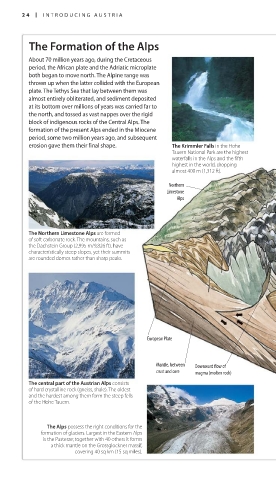
About 70 million years ago, during the Cretaceous
period, the African plate and the Adriatic microplate
both began to move north. The Alpine range was
thrown up when the latter collided with the European
plate. The Tethys Sea that lay between them was
almost entirely obliterated, and sediment deposited
at its bottom over millions of years was carried far to
the north, and tossed as vast nappes over the rigid
block of indigenous rocks of the Central Alps. The
formation of the present Alps ended in the Miocene
period, some two million years ago, and subsequent
erosion gave them their final shape. The Krimmler Falls in the Hohe
Tauern National Park are the highest
waterfalls in the Alps and the fifth
highest in the world, dropping
almost 400 m (1,312 ft).
Northern
Limestone
Alps
The Northern Limestone Alps are formed
of soft carbonate rock. The mountains, such as
the Dachstein Group (2,995 m/9,826 ft), have
characteristically steep slopes, yet their summits
are rounded domes rather than sharp peaks.
European Plate
Mantle, between Downward flow of
crust and core magma (molten rock)
The central part of the Austrian Alps consists
of hard crystalline rock (gneiss, shale). The oldest
and the hardest among them form the steep fells
of the Hohe Tauern.
The Alps possess the right conditions for the
formation of glaciers. Largest in the Eastern Alps
is the Pasterze; together with 40 others it forms
a thick mantle on the Grossglockner massif,
covering 40 sq km (15 sq miles).
024-025_EW_Austria.indd 24 03/09/15 5:40 pm

