


Page 27 - (DK Eyewitness) Travel Guide 2016 - Austria
P. 27
A POR TR AIT OF A USTRIA 25
The end of the Ice Age
marked the beginning of The Austrian Alps
a new type of erosion. The The Austrian Alps are part of the
Northern Limestone Alps European section of the Alpide belt,
have Europe’s largest cave which rose between 70 million and
systems and underground two million years ago. In geological
streams, typical features in terms they form an entity known as
limestone regions.
the Eastern Alps. They occupy an
area about 500 km (310 miles) long
and 150 km (95 miles) wide. One of
Europe’s most fascinating regions,
the Austrian Alps enchant visitors
Mountain with their beautiful high peaks and
Scenery the unique idyllic atmosphere in the
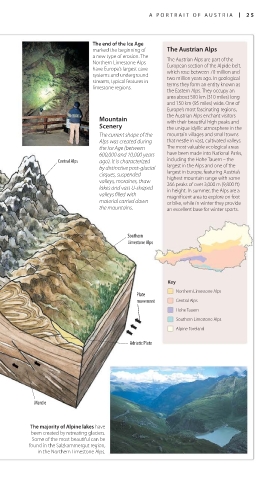
The current shape of the mountain villages and small towns
Alps was created during that nestle in vast, cultivated valleys.
the Ice Age (between The most valuable ecological areas
600,000 and 10,000 years have been made into National Parks,
Central Alps ago). It is characterized including the Hohe Tauern – the
by distinctive post-glacial largest in the Alps and one of the
largest in Europe, featuring Austria’s
cirques, suspended highest mountain range with some
valleys, moraines, thaw 266 peaks of over 3,000 m (9,800 ft)
lakes and vast U-shaped in height. In summer, the Alps are a
valleys filled with magnificent area to explore on foot
material carried down or bike, while in winter they provide
the mountains. an excellent base for winter sports.
Southern
Limestone Alps
Key
Northern Limestone Alps
Plate
movement Central Alps
Hohe Tauern
Southern Limestone Alps
Alpine Foreland
Adriatic Plate
Mantle
The majority of Alpine lakes have
been created by retreating glaciers.
Some of the most beautiful can be
found in the Salzkammergut region,
in the Northern Limestone Alps.
024-025_EW_Austria.indd 25 03/09/15 5:40 pm

