


Page 49 - (DK Eyewitness) Travel Guide 2016 - Austria
P. 49
THE HIST OR Y OF A USTRIA 47
position of Austria, particularly when
confronted with the growing power
of the unifying Germany. Defeat in the
international arena also brought about
changes in internal policy. In 1867, the
emperor signed a treaty with Hungary
and transformed the Austro-Hungarian
Empire into a state consisting of two
parts, united under one common ruler
as well as a common army, finances
The Congress of Vienna in 1815 and foreign policy. The adopted model
of government eased the tensions in
and in fact ruled Austria, became the main Austro-Hungarian relations, but did not
exponent of absolutism and the policy of contribute to the solution of other conflicts,
ethnic oppres sion; hence his nickname, including those with the Czechs, who
“Europe’s coachman”. revolted afresh, led by nationalist feelings.
Internationally, the Empire’s attention
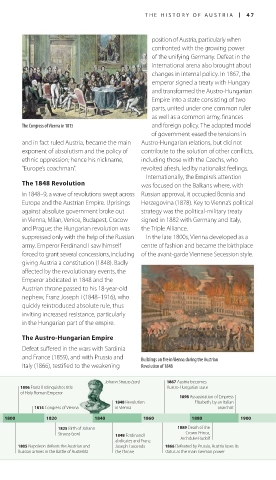
The 1848 Revolution was focused on the Balkans where, with
In 1848–9, a wave of revolutions swept across Russian approval, it occupied Bosnia and
Europe and the Austrian Empire. Uprisings Herzegovina (1878). Key to Vienna’s political
against absolute government broke out strategy was the political-military treaty
in Vienna, Milan, Venice, Budapest, Cracow signed in 1882 with Germany and Italy,
and Prague; the Hungarian revol ution was the Triple Alliance.
suppressed only with the help of the Russian In the late 1800s, Vienna developed as a
army. Emperor Ferdinand I saw himself centre of fashion and became the birth place
forced to grant several concessions, includ ing of the avant-garde Viennese Secession style.
giving Austria a constitution (1848). Badly
affected by the revolutionary events, the
Emperor abdicated in 1848 and the
Austrian throne passed to his 18-year-old
nephew, Franz Joseph I (1848–1916), who
quickly reintroduced absolute rule, thus
inviting increased resistance, particularly
in the Hungarian part of the empire.
The Austro-Hungarian Empire
Defeat suffered in the wars with Sardinia
and France (1859), and with Prussia and Buildings on fire in Vienna during the Austrian
Italy (1866), testified to the weakening Revolution of 1848
Johann Strauss (son) 1867 Austria becomes
1806 Franz II relinquishes title Austro-Hungarian state
of Holy Roman Emperor
1898 Assassination of Empress
1848 Revolution Elisabeth, by an Italian
1815 Congress of Vienna in Vienna anarchist
1800 1820 1840 1860 1880 1900
1825 Birth of Johann 1889 Death of the
Strauss (son) 1848 Ferdinand I Crown Prince,
abdicates and Franz Archduke Rudolf
1805 Napoleon defeats the Austrian and Joseph I ascends 1866 Defeated by Prussia, Austria loses its
Russian armies in the Battle of Austerlitz the throne status as the main German power
046-047_EW_Austria.indd 47 03/09/15 5:40 pm

