


Page 52 - (DK Eyewitness) Travel Guide - Prague
P. 52
50 INTRODUCING PR A GUE
Exploring the Palaces
and Gardens
Prague boasts an amazing number of palaces and gardens,
spanning centuries. Comparatively few palaces were lost to the
ravages of war. Instead, they tended to evolve in style during
restoration or enlargement. Palace gardens became
fashionable in the 17th century, but could only be laid out
where there was space, such as below Prague Castle. More
vulnerable to change, most have been relandscaped several
times. In the 19th century, and again after 1989, many of the
larger parks and private gardens were opened up to the public.
Tuscany Palace, which has a
Medieval Palaces
number of Baroque statues in Bronze Singing Fountain in the Royal
The oldest palace in Prague is the its attic. Several 17th-century Garden by the Belvedere
Old Royal Palace at Prague frescoes were unearthed during
Castle. In the basement is the its reconstruction in the 1990s. geometric, two-tone sgraffito
Romanesque ground floor, designs. Italians also worked
started in about 1135. It has on the Belvedere. Its graceful
been rebuilt many times, Renaissance Palaces arcades and columns, all
particularly between the 14th One of the most beautiful covered with rich reliefs,
and 16th centuries. The heart Renaissance buildings in make this one of the finest
of the Palace, Vladislav Hall, Prague is the 16th-century Renaissance buildings north of
dates from the 1490s and is late Schwarzenberg Palace. The the Alps. The Martinic Palace,
Gothic in structure. Less well work of Italian architects, its built in 1563, was the first
known is the early Baroque façade is entirely covered with example of late-Renaissance
building in Prague. Soon after
came the Lobkowicz Palace.
Its terracotta relief-decorated
windows and plaster sgraffito
have survived later Baroque
modifications. The huge
Archbishop’s Palace was given
a later Rococo façade over its
Renaissance structure.
Baroque Palaces
Many palaces were built in the
Baroque style, and examples of
all its phases still exist in Prague.
A handsome, if ostentatious,
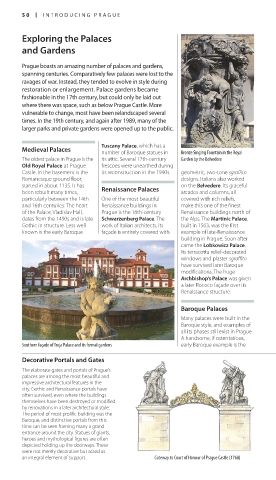
Southern façade of Troja Palace and its formal gardens early Baroque example is the
Decorative Portals and Gates
The elaborate gates and portals of Prague’s
palaces are among the most beautiful and
impressive architectural features in the
city. Gothic and Renaissance portals have
often survived, even where the buildings
themselves have been destroyed or modified
by renovations in a later architectural style.
The period of most prolific building was the
Baroque, and distinctive portals from this
time can be seen framing many a grand
entrance around the city. Statues of giants,
heroes and mythological figures are often
depicted holding up the doorways. These
were not merely decorative but acted as
an integral element of support. Gateway to Court of Honour of Prague Castle (1768)
050-051_EW_Prague.indd 50 20/03/17 11:28 am

