


Page 48 - (DK Eyewitness) Travel Guide - Prague
P. 48
46 INTRODUCING PR A GUE
Exploring Churches
and Synagogues
Religious building began in Prague in the 9th century, reaching
its zenith during the reign of Charles IV (see pp26–7). The remains
of an 11th-century synagogue have been found, but during
the 19th-century clearance of the overcrowded Jewish
ghetto, three synagogues were lost. Many churches were
damaged during the Hussite rebellions (see pp28–9). The
political regime of the 20th century also took its toll, but
now, churches and synagogues have been reclaimed and
restored, with many open to visitors.
reconstruction was carried
Romanesque
out after a fire in 1142, but its
Three reasonably well-preserved chancel, with some exquisite
Romanesque rotundas, dating frescoes on its vaulting, is a
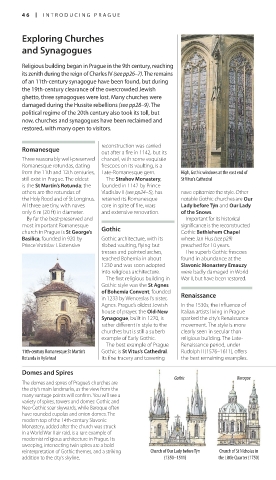
from the 11th and 12th centuries, Late-Romanesque gem. High, Gothic windows at the east end of
still exist in Prague. The oldest The Strahov Monastery, St Vitus’s Cathedral
is the St Martin’s Rotunda; the founded in 1142 by Prince
others are the rotundas of Vladislav II (see pp24–5), has nave epitomize the style. Other
the Holy Rood and of St Longinus. retained its Romanesque notable Gothic churches are Our
All three are tiny, with naves core in spite of fire, wars Lady before Týn and Our Lady
only 6 m (20 ft) in diameter. and extensive renovation. of the Snows.
By far the best-preserved and Important for its historical
most important Romanesque significance is the reconstruc ted
church in Prague is St George’s Gothic Gothic Bethlehem Chapel
Basilica, founded in 920 by Gothic architecture, with its where Jan Hus (see p29)
Prince Vratislav I. Extensive ribbed vaulting, flying but- preached for 10 years.
tresses and pointed arches, The superb Gothic frescoes
reached Bohemia in about found in abundance at the
1230 and was soon adopted Slavonic Monastery Emauzy
into religious architecture. were badly damaged in World
The first religious building in War II, but have been restored.
Gothic style was the St Agnes
of Bohemia Convent, founded
in 1233 by Wenceslas I’s sister, Renaissance
Agnes. Prague’s oldest Jewish In the 1530s, the influence of
house of prayer, the Old-New Italian artists living in Prague
Synagogue, built in 1270, is sparked the city’s Renaissance
rather different in style to the movement. The style is more
churches but is still a suberb clearly seen in secular than
example of Early Gothic. religious building. The Late-
The best example of Prague Renaissance period, under
11th-century Romanesque St Martin’s Gothic is St Vitus’s Cathedral. Rudolph II (1576–1611), offers
Rotunda in Vyšehrad Its fine tracery and towering the best remaining examples.
Domes and Spires
Gothic Baroque
The domes and spires of Prague’s churches are
the city’s main landmarks, as the view from the
many vantage points will confirm. You will see a
variety of spires, towers and domes: Gothic and
Neo-Gothic soar skywards, while Baroque often
have rounded cupolas and onion domes. The
modern top of the 14th-century Slavonic
Monastery, added after the church was struck
in a World War II air raid, is a rare example of
modernist religious architecture in Prague. Its
sweeping, intersecting twin spires are a bold
reinterpretation of Gothic themes, and a striking Church of Our Lady before Týn Church of St Nicholas in Loreto
addition to the city’s skyline. (1350–1511) the Little Quarter (1750) (1725)
046-047_EW_Prague.indd 46 20/03/17 11:28 am
Eyewitness Travel LAYERS PRINTED:
Flashmap follow-on template “UK” LAYER
(Source v1.1)
Date 28th August 2012
Size 125mm x 217mm

