


Page 133 - (DK Eyewitness) Travel Guide - Italian Riviera
P. 133
THE RIVIER A DI LE V ANTE 131
statues, busts, fragments of
frescoes, jewellery, tools, stamps
and ceramics.
k Castelnuovo
di Magra
La Spezia. Road Map F5. * 8,000.
V Sarzana, Santo Stefano Magra.
@ n Via Aurelia 241, 0187 693 306.
_ Corteo Storico “A Pace de Dante”
(end Aug).
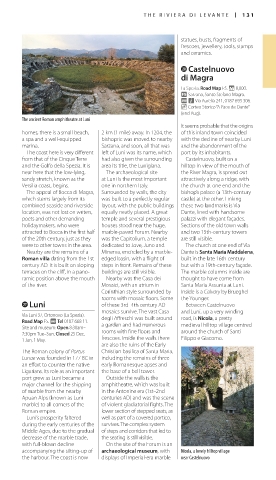
The ancient Roman amphitheatre at Luni
It seems probable that the origins
homes, there is a small beach, 2 km (1 mile) away. In 1204, the of this inland town coincided
a spa and a well-equipped bishopric was moved to nearby with the decline of nearby Luni
marina. Sarzana, and soon, all that was and the abandonment of the
The coast here is very different left of Luni was its name, which port by its inhabitants.
from that of the Cinque Terre had also given the surrounding Castelnuovo, built on a
and the Golfo della Spezia. It is area its title, the Lunigiana. hilltop in view of the mouth of
near here that the low-lying, The archaeological site the River Magra, is spread out
sandy stretch, known as the at Luni is the most important attractively along a ridge, with
Versilia coast, begins. one in northern Italy. the church at one end and the
The appeal of Bocca di Magra, Surrounded by walls, the city bishop’s palace (a 13th-century
which stems largely from its was built to a perfectly regular castle) at the other. Linking
combined seaside and riverside layout, with the public buildings these two landmarks is Via
location, was not lost on writers, equally neatly placed. A great Dante, lined with handsome
poets and other demanding temple and several prestigious palazzi with elegant façades.
holidaymakers, who were houses stood near the huge, Sections of the old town walls
attracted to Bocca in the first half marble-paved Forum. Nearby and two 15th-century towers
of the 20th century, just as they was the Capitolium, a temple are still visible.
were to other towns in the area. dedicated to Jove, Juno and The church at one end of Via
Nearby are the remains of a Minerva, encircled by a marble- Dante is Santa Maria Maddalena,
Roman villa dating from the 1st edged basin, with a flight of built in the late 16th century
century AD. It is built on sloping steps in front. Remains of these but with a 19th-century façade.
terraces on the cliff, in a pano- buildings are still visible. The marble columns inside are
ramic position above the mouth Nearby was the Casa dei thought to have come from
of the river. Mosaici, with an atrium in Santa Maria Assunta at Luni.
Corinthian style surrounded by Inside is a Calvary by Brueghel
rooms with mosaic floors. Some the Younger.
j Luni of these 3rd–4th century AD Between Castelnuovo
mosaics survive. The vast Casa and Luni, up a very winding
Via Luni 37, Ortonovo (La Spezia). degli Affreschi was built around road, is Nicola, a pretty
Road Map F5. @ Tel 0187 668 11.
Site and museum: Open 8:30am– a garden and had numerous medieval hilltop village centred
7:30pm Tue–Sun. Closed 25 Dec, rooms with fine floors and around the church of Santi
1 Jan, 1 May. frescoes. Inside the walls there Filippo e Giacomo.
are also the ruins of the Early
The Roman colony of Portus Christian basilica of Santa Maria,
Lunae was founded in 177 BC in including the remains of three
an effort to counter the native early Romanesque apses and
Ligurians. Its role as an important the base of a bell tower.
port grew as Luni became a Outside the walls is the
major channel for the shipping amphitheatre, which was built
of marble from the nearby in the Antonine era (1st–2nd
Apuan Alps (known as Luni centuries AD) and was the scene
marble) to all corners of the of violent gladiatorial fights. The
Roman empire. lower section of stepped seats, as
Luni’s prosperity faltered well as part of a covered portico,
during the early centuries of the survives. The complex system
Middle Ages, due to the gradual of steps and corridors that led to
decrease of the marble trade, the seating is still visible.
with full-blown decline On the site of the Forum is an
accompanying the silting-up of archaeological museum, with Nicola, a lovely hilltop village
the harbour. The coast is now displays of Imperial-era marble near Castelnuovo
130-131_EW_Italian_Riviera.indd 131 09/09/16 10:47 am

