


Page 142 - (DK Eyewitness) Travel Guide - Italian Riviera
P. 142
140 THE IT ALIAN RIVIER A AREA B Y AREA
5 Savona it is dedicated to works by
Ligurian artists from the Middle
A visitor’s first impression of Savona tends to be of a sprawling Ages to the 20th century.
and industrial port, yet this thriving, untouristy city has a Highlights on the third floor
lovely historic centre. Savona (the name derives from the include Crucifixions by Donato
Ligurian tribe of the Sabates) is the largest town on the Riviera de’ Bardi and Giovanni Mazone,
who were active in the 14th and
di Ponente, and a provincial capital. Its history has always 15th centuries. There is also a
been linked with that of Genoa, and the rivalry between the lovely polyptych (a part of
two has existed since ancient times, when, during Hannibal’s which is in the Paris Louvre) by
Punic wars, Savona sided with Carthage, and Genoa with Mazone entitled Christ on the
Rome. The port (destroyed by the Genoese in 1528) was Cross between the Marys and
St John the Baptist (1460s).
rebuilt in the 1800s, but was heavily bombed in World Many other painters from the
War II. There is plenty to see here: the Fortezza del Priamàr, a 17th and 18th centuries, who
symbol of the city, is now a vast museum complex; visitors were working in both Genoa
can stroll around the medieval centre and port; or explore and Savona, are represented,
the arcades and the Art Nouveau palazzi in Via Paleocapa, including Fiasella, Robatto,
jewels of 19th-century architecture. Guidobono, Brusco, Agostino
and Bozzano. Among the
contemporary art on display,
Eso Peluzzi’s works from the
1920s stand out.
The third floor also houses a
collection of ceramics ranging
from the 12th to the 20th
centuries. Among the items on
display are a particularly fine
majolica jar decorated with
historical scenes, ornamental
vases and a 172-piece collection
of apothecary jars created for a
hospital that used to be located
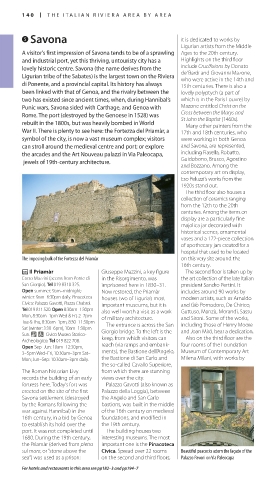
The imposing bulk of the Fortezza del Priamàr on this very site around the
16th century.
P Il Priamàr Giuseppe Mazzini, a key figure The second floor is taken up by
Corso Mazzini (access from Ponte di in the Risorgimento, was the art collection of the late Italian
San Giorgio). Tel 019 8310 325. imprisoned here in 1830–31. president Sandro Pertini. It
Open summer: 9am–midnight; Now restored, the Priamàr includes around 90 works by
winter: 9am–6:30pm daily. Pinacoteca houses two of Liguria’s most modern artists, such as Arnaldo
Civica: Palazzo Gavotti, Piazza Chabrol. important museums, but it is and Giò Pomodoro, De Chirico,
Tel 019 811 520. Open 8:30am–1:30pm also well worth a visit as a work Guttuso, Manzù, Morandi, Sassu
Mon, 8:30am–1pm Wed & Fri, 2–7pm of military architecture. and Sironi. Some of the works,
Tue & Thu, 8:30am–1pm, 8:30–11:30pm The entrance is across the San including those of Henry Moore
Sat (winter: 3:30–6pm), 10am–1:30pm Giorgio bridge. To the left is the and Joan Miró, bear a dedication.
Sun. & 7 Civico Museo Storico- Also on the third floor are the
Archeologico: Tel 019 822 708. keep, from which visitors can
Open Sep–Jun: 10am–12:30pm, reach (via ramps and embank- four rooms of the Foundation
3–5pm Wed–Fri, 10:30am–3pm Sat– ments), the Bastione dell’Angelo, Museum of Contemporary Art
Mon; Jun–Sep: 10:30am–3pm daily. the Bastione di San Carlo and Milena Milani, with works by
the so-called Cavallo Superiore,
The Roman historian Livy from which there are stunning
records the building of an early views over the city.
fortress here. Today’s fort was Palazzo Gavotti (also known as
erected on the site of the first Palazzo della Loggia), between
Savona settlement (destroyed the Angelo and San Carlo
by the Romans following the bastions, was built in the middle
war against Hannibal) in the of the 16th century on medieval
16th century, in a bid by Genoa foundations, and modified in
to establish its hold over the the 19th century.
port. It was not completed until The building houses two
1680. During the 19th century, interesting museums. The most
the Priamàr (derived from pietra important one is the Pinacoteca
sul mare, or “stone above the Civica. Spread over 22 rooms Beautiful peacocks adorn the façade of the
sea”) was used as a prison: on the second and third floors, Palazzo Pavoni on Via Paleocapa
For hotels and restaurants in this area see pp182–3 and pp194–7
140-141_EW_Italian_Riviera.indd 140 09/09/16 10:44 am

