


Page 145 - (DK Eyewitness) Travel Guide - Italian Riviera
P. 145
SA VONA 143
At the far end of by chapels. The Saints, by Ludovico Brea (1495),
Via Pia, at no. 28, is frescoes in the Madonna and saints by Tuccio
Palazzo Della Rovere, central nave, d’Andria (1487) and Adoration
now the police like those of the of the Magi (early 16th century)
headquarters. This presbytery and by the Master of Hoogstraten.
fine palace, begun the transept, were In the cloister alongside
in 1495, was produced between the church are 21 marble
designed by 1847 and 1951. statues of saints. At the far
Giuliano da The walls and the end is Savona’s own Cappella
Sangallo (one cupola (dated 1840) Sistina, built in 1481 for another
of the architects were decorated Della Rovere pope, Sixtus IV
of St Peter’s in between 1891 and (for whom the Sistine Chapel
Rome) for Statue of the Assumption on 1893. In the presby- in the Vatican was built), as a
Cardinal Giuliano the cathedral tery is a master piece resting place for his parents.
Della Rovere, later by Albertino Piazza, The interior of the chapel was
Pope Julius II. It became the Enthroned Madonna with Child transformed in the 18th
property of the Spinola family and saints Peter and Paul, and century, when rococo
and then, in 1673, was acquired Presentation of Mary at the decoration in the form of
by the Order of the Poor Clares. Temple, a marble relief dating multicoloured stucco was
The nuns covered up the from the 16th cen tury. introduced. The marble tomb
magnificent interior decoration Also in the presbytery stand of Sixtus IV’s parents (1483) is
with plaster and renamed the splendid wooden choir on the left-hand side.
it Palazzo Santa Chiara. At stalls, dated 1515. Commissioned
one stage it was the and financed by the Republic R Nostra Signora
Napoleonic prefecture. of Savona and Cardinal Giuliano di Castello
With its façade divided into Della Rovere for the first Corso Italia. Tel 019 804 892.
three storeys with pilasters, cathedral, they were removed Open Sun am, for Mass.
its two-tone marble cladding, from their original setting and This small oratory is almost
and its vast courtyard, this then remodelled for the new hidden from view on Corso
palazzo is a clear example of semicircular apse. Italia, a long street of elegant
Tuscan architecture, a rarity in In one of the chapels in the shops which, along with
the region. Only very few of the left-hand aisle is a notable fresco Via Paleocapa, was the most
splendid original frescoes are of the Madonna della Colonna important road built during
now visible inside. (early 15th century), originally the expansion of Savona in
on a column in the Franciscan the 19th century. It houses
R Cattedrale di Nostra monastery on whose site the one of the finest paintings in
Signora Assunta current cathedral was con struc- the city – a late 15th-century
Piazza del Duomo. ted. Also of interest is the pulpit polyptych of the Madonna and
Museo del Tesoro della Cattedrale: of the Evangelists (1522). Saints, by the Lombard artist
Tel 019 813 003. Open 10am–noon, To the left of the presbytery Vincenzo Foppa, completed
4–5:30pm Sat. there is access to the Museo by Ludovico Brea (one of
This church was built in the del Tesoro della Cattedrale, a Liguria’s most active painters
late 16th century to replace treasury museum with works at that time).
the old cathedral of Santa Maria from different sources. The The oratory also contains
del Castello, which had been core of the collection dates what is claimed to be the
demolished (along with other from the first half of the 14th world’s tallest processional
buildings) to make space for century. Other works include float, Deposition built by
the Priamàr fortress. Many of a polyp tych, Assumption and Filippo Martinengo in 1795.
the contents of the old building
were transferred to the new
one, including the splendid
baptismal font, made from a
beautifully carved Byzantine
capital, and a late 15th-century
marble Crucifixion – both are
found in the central nave,
behind the façade.
The imposing marble façade
dates from the late 19th century
and features, above the central
door, Assumption by the Carrara
artist, Cybei (1706–84). Inside,
the three aisles are divided by
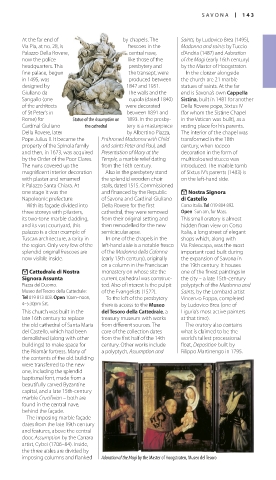
imposing columns and flanked Adoration of the Magi by the Master of Hoogstraten, Museo del Tesoro
142-143_EW_Italian_Riviera.indd 143 09/09/16 10:48 am

