


Page 174 - (DK Eyewitness) Travel Guide - Italian Riviera
P. 174
172 THE IT ALIAN RIVIER A AREA B Y AREA
the Hanbury Botanical Gardens
(see pp174–5).
The River Roia divides
Ventimiglia into two: the
medieval part on a hill to the
west, and the modern town
on the coastal plain to the east.
Traces of the era of Roman
domination, which followed
rule by the Liguri Intemelii
people, can be seen at
Albintimilium, on the eastern
periphery of the new town. Marble cover of a funerary urn,
Clearly visible from the flyover 1st century AD
on the Via Aurelia, the ruins
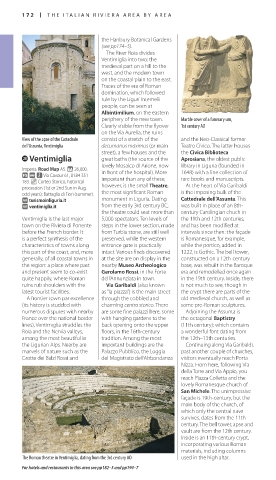
View of the apse of the Cattedrale consist of a stretch of the and the Neo-Classical former
dell’Assunta, Ventimiglia decumanus maximus (or main Teatro Civico. The latter houses
street), a few houses and the the Civica Biblioteca
k Ventimiglia great baths (the source of the Aprosiana, the oldest public
lovely Mosaico di Arione, now library in Liguria (founded in
Imperia. Road Map A5. * 26,000.
V @ n Via Cavour 61, 0184 351 in front of the hospital). More 1648) with a fine collection of
183. _ Corteo Storico, historical important than any of these, rare books and manuscripts.
procession (1st or 2nd Sun in Aug, however, is the small Theatre, At the heart of Via Garibaldi
odd years); Battaglia di Fiori (summer). the most significant Roman is the imposing bulk of the
∑ turismoinliguria.it monument in Liguria. Dating Cattedrale dell’Assunta. This
∑ ventimiglia.it from the early 3rd century BC, was built in place of an 8th-
the theatre could seat more than century Carolingian chuch in
Ventimiglia is the last major 5,000 spectators. Ten levels of the 11th and 12th centuries,
town on the Riviera di Ponente steps in the lower section, made and has been modified at
before the French border. It from Turbia stone, are still well intervals since then: the façade
is a perfect synthesis of the preserved, while the western is Romanesque, for example,
characteristics of towns along entrance gate is practically while the portico, added in
this part of the coast, and, more intact. Various finds discovered 1222, is Gothic. The bell tower,
generally, of all coastal towns in at the site are on display in the constructed on a 12th-century
the region: a place where past nearby Museo Archeologico base, was rebuilt in the Baroque
and present seem to co-exist Gerolamo Rossi, in the Forte era and remodelled once again
quite happily, where Roman dell’Annunziata in town. in the 19th century. Inside, there
ruins rub shoulders with the Via Garibaldi (also known is not much to see, though in
latest tourist facilities. as “la piazza”) is the main street the crypt there are parts of the
A frontier town par excellence through the cobbled and old medieval church, as well as
(its history is studded with charming centro storico. There some pre-Roman sculptures.
numerous disputes with nearby are some fine palazzi here, some Adjoining the Assunta is
France over the national border with hanging gardens to the the octagonal Baptistry
lines), Ventimiglia straddles the back opening onto the upper (11th century); which contains
Roia and the Nervia valleys, floors, in the 16th-century a wonderful font dating from
among the most beautiful in tradition. Among the most the 12th–13th centuries.
the Ligurian Alps. Nearby are important buildings are the Continuing along Via Garibaldi,
marvels of nature such as the Palazzo Pubblico, the Loggia past another couple of churches,
Grotte dei Balzi Rossi and del Magistrato dell’Abbondanza visitors eventually reach Porta
Nizza. From here, following Via
della Torre and Via Appio, you
reach Piazza Colletta and the
lovely Romanesque church of
San Michele. The unimpressive
façade is 19th-century, but the
main body of the church, of
which only the central nave
survives, dates from the 11th
century. The bell tower, apse and
vault are from the 12th century.
Inside is an 11th-century crypt,
incorporating various Roman
materials, including columns
The Roman theatre in Ventimiglia, dating from the 3rd century AD used in the high altar.
For hotels and restaurants in this area see pp182–3 and pp194–7
172-173_EW_Italian_Riviera.indd 172 09/09/16 10:48 am

