


Page 71 - (DK Eyewitness) Travel Guide - Italian Riviera
P. 71
IL CENTRO ST ORIC O 69
Door Carvings
A recurrent sight in
the Centro Storico
are the doorways
featuring carvings
sculpted from marble or
the characteristic black
Slate ornamental panel showing St George stone of Promontorio
and the Dragon (from the Lavagna area).
These panels were the
product of economic necessity and the scarcity of building space:
in the 15th century, noble families were obliged to extend the use One of the Doria palazzi in Piazza
of the ground floors of their palazzi in order to accommodate
shops, and they therefore wanted to create handsome new San Matteo
doorways that would make their own residences stand out. Famous
sculptors (in particular, members of the Gagini family) developed the civic senate, was given
this craft, often producing work of great skill. Among the most to the admiral in 1528.
common subjects were the triumphs of the commissioning family The small church of San
or holy scenes such as St George killing the dragon. There are some Matteo, the family place of
examples in the Museo di Sant’Agostino. worship of the Dorias, built in
1125, was rebuilt in the late
13th century in Gothic style.
its political clique in a distinct Pilasters divide the black-and-
area of the city. Despite changes white striped façade into three,
to the palazzi facing the square, corre sponding to the aisles.
the piazza has kept its original The interior was altered in the
compact form and a distinct 16th century for Andrea Doria,
charm – something that is who is buried in the crypt, as
missing from other similar areas. is his ancestor Lamba Doria.
The buildings bear typical Giovanni Battista Castello,
wall coverings of striped black- known as il Bergamasco,
and-white marble, characteristic modified the nave and aisles
of Gothic civic buildings. Of and painted the nave vault
particular note is Palazzo di (1557–9), a collaboration with
Lamba Doria, at no. 15, named Luca Cambiaso. The statues
after the family member who in the apse niches and the
defeated the Venetian fleet at decoration of the presbytery
Curzola in 1298 – the typical and the cupola (1543–7) are
The Romanesque bell tower of Santa structure of a medieval Genoese by Angelo Montorsoli.
Maria delle Vigne palazzo is still in evidence. Also To the left of the church
noteworthy is Palazzo di is a pretty cloister (1308),
the early 20th century. The Andrea Doria, at no. 17, which, with pointed arches resting
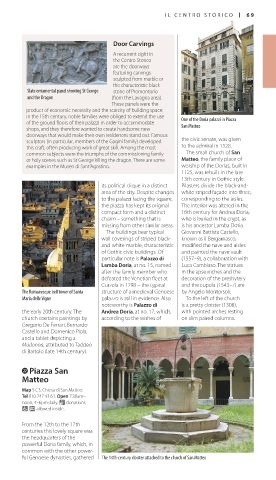
church contains paintings by according to the wishes of on slim paired columns.
Gregorio De Ferrari, Bernardo
Castello and Domenico Piola,
and a tablet depicting a
Madonna, attributed to Taddeo
di Bartolo (late 14th century).
s Piazza San
Matteo
Map 5 C3. Chiesa di San Matteo:
Tel 010 247 43 61. Open 7:30am–
noon, 4–6pm daily. & donations.
7 ^ allowed inside.
From the 12th to the 17th
centuries this lovely square was
the headquarters of the
powerful Doria family, which, in
common with the other power-
ful Genoese dynasties, gathered The 14th-century cloister attached to the church of San Matteo
068-069_EW_Italian_Riviera.indd 69 09/09/16 10:47 am

