


Page 74 - (DK Eyewitness) Travel Guide - Italian Riviera
P. 74
72 GENO A AREA B Y AREA
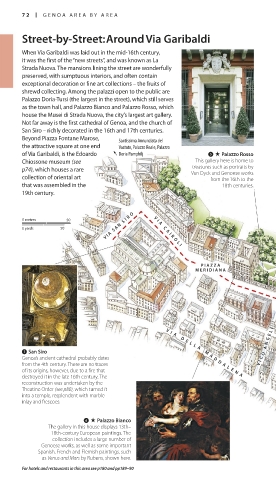
Street-by-Street: Around Via Garibaldi
When Via Garibaldi was laid out in the mid-16th century,
it was the first of the “new streets”, and was known as La
Strada Nuova. The mansions lining the street are wonderfully
preserved, with sumptuous interiors, and often contain
exceptional decoration or fine art collections – the fruits of
shrewd collecting. Among the palazzi open to the public are
Palazzo Doria-Tursi (the largest in the street), which still serves
as the town hall, and Palazzo Bianco and Palazzo Rosso, which
house the Musei di Strada Nuova, the city’s largest art gallery.
Not far away is the first cathedral of Genoa, and the church of
San Siro – richly decorated in the 16th and 17th centuries.
Beyond Piazza Fontane Marose, Santissima Annunziata del
the attractive square at one end Vastato, Palazzo Reale, Palazzo
of Via Garibaldi, is the Edoardo Doria Pamphilj 5 . Palazzo Rosso
Chiossone museum (see This gallery here is home to
treasures such as portraits by
p74), which houses a rare Van Dyck and Genoese works
collection of oriental art from the 16th to the
that was assembled in the 18th centuries.
19th century.
V I A S A N S I R O
0 metres 50
0 yards 50 V I A C A I R O L I
PIA ZZ A
MERIDIANA
V I C O A N G E L I
7 San Siro V I A D E L L A M A D D A L E N A
Genoa’s ancient cathedral probably dates V I A S A L V A G H I
from the 4th century. There are no traces
of its origins, however, due to a fire that
destroyed it in the late 16th century. The
reconstruction was undertaken by the
Theatine Order (see p80), which turned it
into a temple, resplendent with marble
inlay and frescoes.
6 . Palazzo Bianco
The gallery in this house displays 13th–
18th-century European paintings. The
collection includes a large number of
Genoese works, as well as some important
Spanish, French and Flemish paintings, such
as Venus and Mars by Rubens, shown here.
For hotels and restaurants in this area see p180 and pp189–90
072-073_EW_Italian_Riviera.indd 72 09/09/16 10:47 am

