


Page 76 - (DK Eyewitness) Travel Guide - Italian Riviera
P. 76
74 GENO A AREA B Y AREA
1 Piazza Fontane 2 Museo di Arte
Marose Orientale Edoardo
Map 6 D2. Chiossone
Villetta Di Negro, Piazzale Mazzini 4.
This square owes its name Map 6 D2. Tel 010 542 285. Open Apr–
to an ancient fountain (fonte), Oct: 9am–6pm Tue (to 7pm Wed–Sat),
which was recorded in a 13th 9:30am–7:30pm Sun; Nov–Mar: 9am–
century document but destroyed 6:30pm Tue–Fri, 9:30am–6:30pm Sat
in the 19th century. The piazza & Sun. Closed public hols. & 7
ground floor. ∑ museidigenova.it
is attractive and free of traffic,
but has an “assembled” look,
the result of numerous Genoa’s Museum of Oriental
changes in the layout, Art is set within the Parco
and of the variations in della Villetta Di Negro,
street level. which was designed as a
Among the palazzi garden of acclimatization
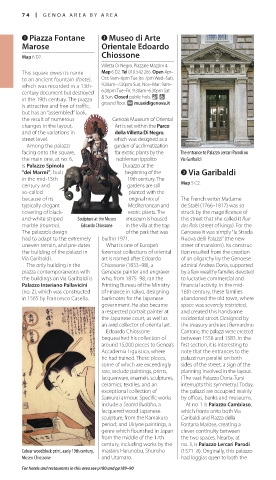
facing onto the square, for exotic plants by the The entrance to Palazzo Lercari Parodi on
the main one, at no. 6, nobleman Ippolito Via Garibaldi
is Palazzo Spinola Durazzo at the
“dei Marmi”, built begin ning of the 3 Via Garibaldi
in the mid15th 19th cen tury. The Map 5 C2.
century and gardens are still
socalled planted with the
because of its original mix of The French writer Madame
typically elegant Mediterranean and de Staël (1766–1817) was so
covering of black exotic plants. The struck by the magnificence of
andwhite striped Sculpture at the Museo museum is housed this street that she called it Rue
marble (marmo). Edoardo Chiossone in the villa at the top des Rois (street of kings). For the
The palazzo’s design of the park that was Genoese it was simply “la Strada
had to adapt to the extremely built in 1971. Nuova delli Palazzi” (the new
uneven terrain, and predates What is one of Europe’s street of mansions). Its construc
the building of the palazzi in foremost collections of oriental tion resulted from the creation
Via Garibaldi. art is named after Edoardo of an oligarchy by the Genoese
The only building in the Chiossone (1833–98), a admiral Andrea Doria, supported
piazza contemporaneous with Genoese painter and engraver by a few wealthy families devoted
the buildings on Via Garibaldi is who, from 1875–98, ran the to lucrative commercial and
Palazzo Interiano Pallavicini Printing Bureau of the Ministry financial activity. In the mid
(no. 2), which was constructed of Finance in Tokyo, designing 16th century, these families
in 1565 by Francesco Casella. banknotes for the Japanese abandoned the old town, where
government. He also became space was severely restricted,
a respected portrait painter at and created this handsome
the Japanese court, as well as residential street. Designed by
an avid collector of oriental art. the treasury architect Bernardino
Edoardo Chiossone Cantone, the palazzi were erected
bequeathed his collection of between 1558 and 1583. In the
around 15,000 pieces to Genoa’s first section, it is interesting to
Accademia Liguistica, where note that the entrances to the
he had trained. These pieces, palazzi run parallel on both
some of which are exceedingly sides of the street, a sign of the
rare, include paintings, prints, planning involved in the layout.
lacquerware, enamels, sculptures, (The vast Palazzo DoriaTursi
ceramics, textiles, and an interrupts this symmetry.) Today,
exceptional collection of the palazzi are occupied mainly
Samurai armour. Specific works by offices, banks and museums.
include a Seated Buddha, a At no. 1 is Palazzo Cambiaso,
lacquered wood Japanese which fronts onto both Via
sculpture, from the Kamakura Garibaldi and Piazza della
period; and Ukiyoe paintings, a Fontana Marose, creating a
genre which flour ished in Japan clever continuity between
from the middle of the 17th the two spaces. Nearby, at
century, including works by the no. 3, is Palazzo Lercari Parodi
Colour woodblock print, early 19th century, masters Harunobu, Shunsho (1571–8). Originally, this palazzo
Museo Chiossone and Utamaro. had loggias open to both the
For hotels and restaurants in this area see p180 and pp189–90
074-075_EW_Italian_Riviera.indd 74 09/09/16 10:47 am

