


Page 80 - (DK Eyewitness) Travel Guide - Italian Riviera
P. 80
78 GENO A AREA B Y AREA
Exploring Palazzo Rosso Room 5 contains works
by Guercino (1591–1666),
The main museum takes up two floors, and occupies rooms including the fine Dying
which are still decorated with antique furniture, sculptures, Cleopatra, bought by one of
mirrors and porcelain. On the upper floor (the only one to the Durazzo family in 1648.
By the same artist is the Suicide
have been lived in) are rooms frescoed by the great painters of Catone Uticense (1641) and
of the 17th century in Liguria, magnificent examples of God the Father with Angel
Baroque decoration. The paintings of the Brignole-Sale family, (c.1620), once part of an altar
which form the core of the art collection, are primarily works painting entitled Vestizione di
by Italian and Flemish masters and the Genoese school, San Guglielmo, now in the
reflecting the taste prevalent in the centuries during which Pinacoteca Nazionale di Bologna.
Room 6 is devoted to
the collection was formed. Palazzo Rosso combines 17th-century Neapolitan
beautifully and seamlessly the role of a noble residence painting, including several works
with that of a gallery of art, assembled by a family of by Mattia Preti, such as The
Genoese patricians. Resurrection of Lazarus (1630–40),
which employs a dramatic use
of light and shade.
as the latter’s Judith and
Holofernes. Other works here
are by Paris Bordone and Rooms 7–10: Genoese
Alessandro Bonvicini (also Painting from the
known as il Moretto). The 16–18th Centuries
painting Madonna and Child, These rooms document the
St John the Baptist and Mary richness and high quality of
Magdalen (1520–22) by the works produced by the
Palma il Vecchio, is a beautiful Genoa school during the city’s
work featuring a lovely use so-called golden age, a period
of colour. of great economic and cultural
Room 4 has 17th- fervour that lasted from the
century paintings of the 16th to the 18th centuries.
Emilian school, among Room 7 is dedicated to local
them Annunciation by artist Bernardo Strozzi (1581–
Judith and Holofernes by Paolo Veronese, Ludovico Carracci, who was 1644). His paintings range from
displaying great mastery of colour a key figure in the Bolo gnese the youthful La Carità to two
school, along with his cousins devotional paintings depicting
Agostino and Annibale. Among St Francis and magnificent works
Rooms 1–6: Italian Carracci’s pupils was Guido Reni, from his mature phase, such as
and European Painting, whose St Sebastian (1615–16) Madonna with Child and San
15–17th Centuries reveals his ability to depict a Giovannino, showing the
The collection of paintings range of emotions through clear influence of Caravaggio,
was assembled by the Brignole- measured, classical painting. and The Cook, showing a
Sale family, whose acquisitions The works of Giulio Cesare Flemish influence.
lasted for more than two cen- Procaccini are also of interest. In Room 9 are paintings by
turies. The marriage between Sinibaldo Scorza (1589–1631)
Giovan Francesco Brignole-Sale and Giovanni Battista Castig-
and Maria Durazzo strengthened lione, known as il Grechetto
the collection further. (1609–64). Scorza was primarily
Room 1 has a fine Portrait a painter of landscapes and
of Maria Brignole-Sale (1856), animals, while il Grechetto, a
one of many family portraits. draughtsman and engraver,
In Room 2, in addition to the dealt with pastoral themes. Il
Madonna with Child, St Joseph Grechetto was a brilliant
and St John as a Child by an interpreter of biblical scenes: his
artist of the Perin del Vaga Flight of the Family of Abraham
school, is Portrait of a Man (1630s) is a good example.
(15th century) thought to be Room 10 is dedicated to
by Michele Giambono or Genoese artists of the 17th
Gentile da Fabriano. and 18th centuries, including
Room 3 is dedicated to the Pellegro Piola, Giovanni Bernardo
Venetian school from the 16th Carbone and Bernardo Castello –
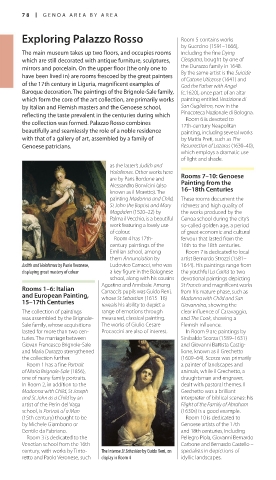
century, with works by Tinto- The intense St Sebastian by Guido Reni, on specialists in depictions of
retto and Paolo Veronese, such display in Room 4 idyllic landscapes.
078-079_EW_Italian_Riviera.indd 78 09/09/16 10:47 am

