


Page 90 - (DK Eyewitness) Travel Guide - Italian Riviera
P. 90
88 GENO A AREA B Y AREA
3 Parco Durazzo Pallavicini
The man responsible for transforming the gardens of the Villa
Durazzo Pallavicini was Michele Canzio, set designer at Genoa’s
Teatro Carlo Felice (see p59). Between 1837 and 1846 he created
a splendid English-style garden, following the romantic fashion of
the time. He was commissioned by Marchese Ignazio Alessandro
Pallavicini, who inherited the villa from his aunt Clelia Pallavicini
Durazzo. She was passionate about plants and had begun a botanic
garden here in the late 18th century. Today, more than 100 varieties
of exotic species, including tropical carnivorous plants, are grown
here. The park covers around 11 ha (27 acres).
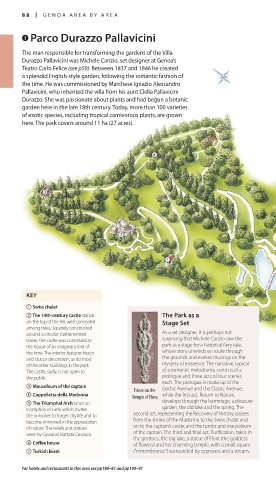
KEY
1 Swiss chalet
2 The 14th-century castle stands The Park as a
on the top of the hill, well concealed Stage Set
among trees. Squarely constructed
around a circular, battlemented As a set designer, it is perhaps not
tower, the castle was conceived as surprising that Michele Canzio saw the
the house of an imaginary lord of park as a stage for a historical fairy tale,
the time. The interior features fresco whose story unwinds en route through
and stucco decoration, as do most the grounds and evokes musings on the
of the other buildings in the park. mystery of existence. The narrative, typical
The castle, sadly, is not open to of a romantic melodrama, consists of a
the public. prologue and three acts of four scenes
each. The prologue is made up of the
3 Mausoleum of the captain Frieze on the Gothic Avenue and the Classic Avenue,
4 Cappelletta della Madonna Temple of Flora while the first act, Return to Nature,
5 The Triumphal Arch bears an develops through the hermitage, a pleasure
inscription in Latin which invites garden, the old lake and the spring. The
the onlooker to forget city life and to second act, representing the Recovery of History, passes
become immersed in the appreciation from the shrine of the Madonna to the Swiss chalet and
of nature. The reliefs and statues on to the captain’s castle, and the tombs and mausoleum
were by Giovanni Battista Cevasco. of the captain. The third and final act, Purification, takes in
the grottoes, the big lake, a statue of Flora (the goddess
6 Coffee house of flowers) and her charming temple, with a small square
7 Turkish kiosk (“remembrance”) surrounded by cypresses and a stream.
For hotels and restaurants in this area see pp180–81 and pp190–91
088-089_EW_Italian_Riviera.indd 88 09/09/16 10:44 am

