


Page 93 - (DK Eyewitness) Travel Guide - Italian Riviera
P. 93
FUR THER AFIELD 91
triptych on the high altar, Coppedè, which embraces
Madonna and Saints, by Turino medieval, Renaissance and
Vanni (1415). even Art Nouveau influences.
Travelling along the line of
9 City Walls and the walls in an anti-clockwise
Fortresses direction, you reach Forte
Castellaccio, mentioned in
Parco Urbano della Mura. V Genova– the 13th century but rebuilt
Casella line. @ 40, 64. £ Zecca–Righi in the 16th century by Andrea
funicular (terminus). 8 organized by Doria, and again altered in the
the Tourism & Development Office 1830s. Within its ring of bastions
(www.visitgenoa.it). is the Torre della Specola,
where condemned men
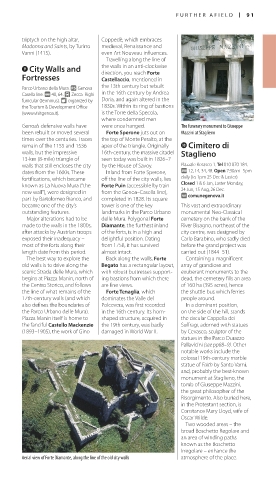
Genoa’s defensive walls have were once hanged. The funerary monument to Giuseppe
been rebuilt or moved several Forte Sperone juts out on Mazzini at Staglieno
times over the centuries. Traces the top of Monte Peralto, at the
remain of the 1155 and 1536 apex of the triangle. Originally 0 Cimitero di
walls, but the impressive 16th-century, the massive citadel Staglieno
13-km (8-mile) triangle of seen today was built in 1826–7
walls that still encloses the city by the House of Savoy. Piazzale Resasco 1. Tel 010 870 184.
dates from the 1600s. These Inland from Forte Sperone, @ 12, 14, 34, 48. Open 7:30am–5pm
fortifications, which became off the line of the city walls, lies daily (to 1pm 25 Dec & Easter).
known as La Nuova Mura (“the Forte Puin (accessible by train Closed 1 & 6 Jan, Easter Monday,
new wall”), were designed in from the Genoa–Casella line), 24 Jun, 15 Aug, 26 Dec.
∑ comunegenova.it
part by Bartolomeo Bianco, and completed in 1828. Its square
became one of the city’s tower is one of the key This vast and extraordinary
outstanding features. landmarks in the Parco Urbano monumental Neo-Classical
Major alterations had to be delle Mura. Polygonal Forte cemetery on the bank of the
made to the walls in the 1800s, Diamante, the furthest inland River Bisagno, northeast of the
after attacks by Austrian troops of the forts, is in a high and city centre, was designed by
exposed their inadequacy – delightful position. Dating Carlo Barabino, who sadly died
most of the forts along their from 1758, it has survived before the grand project was
length date from this period. almost intact. carried out (1844–51).
The best way to explore the Back along the walls, Forte Containing a magnificent
old walls is to drive along the Begato has a rectangular layout, array of grandiose and
scenic Strada delle Mura, which with robust buttresses support- exuberant monuments to the
begins at Piazza Manin, north of ing bastions from which there dead, the cemetery fills an area
the Centro Storico, and follows are fine views. of 160 ha (395 acres), hence
the line of what remains of the Forte Tenaglia, which the shuttle bus which ferries
17th-century walls (and which dominates the Valle del people around.
also defines the boundaries of Polcevera, was first recorded In a dominant position,
the Parco Urbano delle Mura). in the 16th century. Its horn- on the side of the hill, stands
Piazza Manin itself is home to shaped structure, acquired in the circular Cappella dei
the fanciful Castello Mackenzie the 19th century, was badly Suffragi, adorned with statues
(1893–1905), the work of Gino damaged in World War II. by Cevasco, sculptor of the
statues in the Parco Durazzo
Pallavicini (see pp88–9). Other
notable works include the
colossal 19th-century marble
statue of Faith by Santo Varni,
and, probably the best-known
monument at Staglieno, the
tomb of Giuseppe Mazzini,
the great philosopher of the
Risorgimento. Also buried here,
in the Protestant section, is
Constance Mary Lloyd, wife of
Oscar Wilde.
Two wooded areas – the
broad Boschetto Regolare and
an area of winding paths
known as the Boschetto
Irregolare – enhance the
Aerial view of Forte Diamante, along the line of the old city walls atmosphere of the place.
090-091_EW_Italian_Riviera.indd 91 09/09/16 10:47 am

