


Page 92 - (DK Eyewitness) Travel Guide - Italian Riviera
P. 92
90 GENO A AREA B Y AREA
from which the sanctuary a 19th-century building, but
takes its name – it is the still has its bell tower, dating
work of Giovanni Romano. from 1300.
In the chapel alongside is San Bartolomeo owes its
a wooden Pietà (1733), by fame to the fact that it is home
Anton Maria Maragliano. to the relic of Santo Volto (Holy
The sanctuary’s crypt Face), a piece of linen with an
houses some of Genoa’s image of the face of Jesus Christ.
best-loved nativity scenes People also call it “Santo
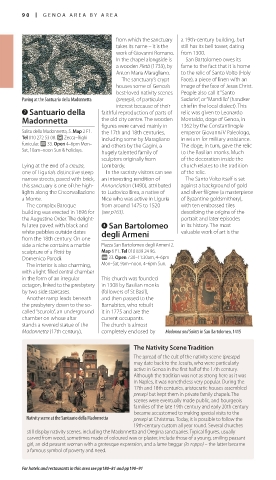
Paving at the Santuario della Madonnetta (presepi), of particular Sudario”, or “Mandillo” (handker-
interest because of their chief in the local dialect). This
7 Santuario della faithful reproduction of parts of relic was given to Leonardo
Madonnetta the old city centre. The wooden Montaldo, doge of Genoa, in
figures were carved mainly in 1362 by the Constantinople
Salita della Madonnetta, 5. Map 2 F1. the 17th and 18th centuries, emperor Giovanni V Paleologo,
Tel 010 272 53 08. £ Zecca–Righi including some by Maragliano in return for military assistance.
funicular. @ 33. Open 4–6pm Mon– and others by the Gagini, a The doge, in turn, gave the relic
Sat, 10am–noon Sun & holidays.
hugely talented family of to the Basilian monks. Much
sculptors originally from of the decoration inside the
Lying at the end of a creuza, Lombardy. church relates to the tradition
one of Liguria’s distinctive steep In the sacristy visitors can see of the relic.
narrow streets, paved with brick, an interesting rendition of The Santo Volto itself is set
this sanctuary is one of the high- Annunciation (1490), attributed against a background of gold
lights along the Circonvallazione to Ludovico Brea, a native of and silver filigree (a masterpiece
a Monte. Nice who was active in Liguria of Byzantine goldsmithery),
The complex Baroque from around 1475 to 1520 with ten embossed tiles
building was erected in 1696 for (see p163). describing the origins of the
the Augustine Order. The delight- portrait and later episodes
ful area paved with black and 8 San Bartolomeo in its history. The most
white pebbles outside dates degli Armeni valuable work of art is the
from the 18th century. On one
side a niche contains a marble Piazza San Bartolomeo degli Armeni 2.
sculpture of a Pietà by Map 6 F1. Tel 010 839 24 96.
Domenico Parodi. @ 33. Open 7:30–11:30am, 4–6pm
The interior is also charming, Mon–Sat, 9am–noon, 4–6pm Sun.
with a light-filled central chamber
in the form of an irregular This church was founded
octagon, linked to the presbytery in 1308 by Basilian monks
by two side staircases. (followers of St Basil),
Another ramp leads beneath and then passed to the
the presbytery down to the so- Barnabites, who rebuilt
called “scurolo”, an underground it in 1775 and are the
chamber on whose altar current occupants.
stands a revered statue of the The church is almost
Madonnetta (17th century), completely enclosed by Madonna and Saints in San Bartolomeo, 1415
The Nativity Scene Tradition
The spread of the cult of the nativity scene (presepe)
may date back to the Jesuits, who were particularly
active in Genoa in the first half of the 17th century.
Although the tradition was not as strong here as it was
in Naples, it was nonetheless very popular. During the
17th and 18th centuries, aristocratic houses assembled
presepi but kept them in private family chapels. The
scenes were eventually made public, and bourgeois
families of the late 19th century and early 20th century
became accustomed to making special visits to the
Nativity scene at the Santuario della Madonnetta presepi at Christmas. Today, it is possible to follow the
19th-century custom all year round. Several churches
still display nativity scenes, including the Madonnetta and Oregina sanctuaries. Typical figures, usually
carved from wood, sometimes made of coloured wax or plaster, include those of a young, smiling peasant
girl, an old peasant woman with a grotesque expression, and a lame beggar (lo zoppo) – the latter became
a famous symbol of poverty and need.
For hotels and restaurants in this area see pp180–81 and pp190–91
090-091_EW_Italian_Riviera.indd 90 09/09/16 10:47 am

