


Page 43 - (DK Eyewitness) Travel Guide - New Orleans
P. 43
ne w orleans a t a glance 41
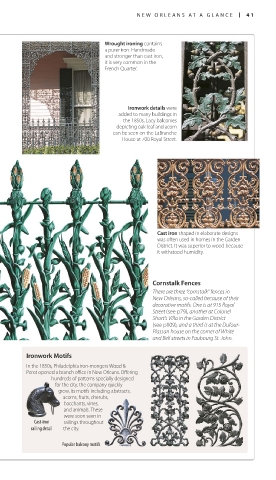
Wrought ironing contains
a purer iron. Handmade
and stronger than cast iron,
it is very common in the
French Quarter.
Ironwork details were
added to many buildings in
the 1850s. Lacy balconies
depicting oak leaf and acorn
can be seen on the LaBranche
House at 700 Royal Street.
Cast iron shaped in elaborate designs
was often used in homes in the Garden
District. It was superior to wood because
it withstood humidity.
Cornstalk Fences
There are three “cornstalk” fences in
New Orleans, so-called because of their
decorative motifs. One is at 915 Royal
Street (see p79), another at Colonel
Short’s Villa in the Garden District
(see p109), and a third is at the Dufour-
Plassan house on the corner of White
and Bell streets in Faubourg St. John.
Ironwork Motifs
In the 1850s, Philadelphia iron-mongers Wood &
Perot opened a branch office in New Orleans. Offering
hundreds of patterns specially designed
for the city, the company quickly
grew, its motifs including abstracts,
acorns, fruits, cherubs,
bacchants, vines,
and animals. These
were soon seen in
Cast-iron railings throughout
railing detail the city.
Popular balcony motifs
040-041_EW_New_Orleans.indd 41 13/08/14 2:11 pm

