


Page 38 - (DK Eyewitness) Travel Guide - New Orleans
P. 38
36 INTRODUCING N e w ORlea N s
The Architecture of New Orleans
New Orleans is one of the few american cities that has managed
to retain much of its historic architecture. The French quarter
has many buildings dating back 150 years or more, while the
Garden District has splendid mansions designed in a variety
of styles. Beautiful houses line esplanade avenue, historically
the residential nucleus of the Creole elite, and the city also
possesses a good stock of 19th-century public buildings built in
Greek Revival style. It is not always easy to categorize buildings
by style, for many of them are hybrids, like the Gallier House,
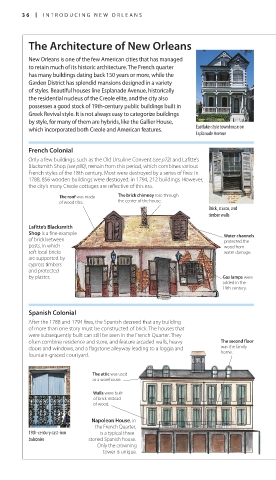
which incorporated both Creole and american features. Eastlake-style townhouse on
Esplanade Avenue
French Colonial
Only a few buildings, such as the Old Ursuline Convent (see p72) and Lafitte’s
Blacksmith Shop (see p80), remain from this period, which combines various
French styles of the 18th century. Most were destroyed by a series of fires: in
1788, 856 wooden buildings were destroyed; in 1794, 212 buildings. However,
the city’s many Creole cottages are reflective of this era.
The roof was made The brick chimney rose through
of wood tiles. the center of the house.
Brick, stucco, and
timber walls
Lafitte’s Blacksmith
Shop is a fine example Water channels
of brick between protected the
posts, in which wood from
soft local bricks water damage.
are supported by
cypress timbers
and protected
by plaster. Gas lamps were
added in the
19th century.
Spanish Colonial
After the 1788 and 1794 fires, the Spanish decreed that any building
of more than one story must be constructed of brick. The houses that
were subsequently built can still be seen in the French Quarter. They
often combine residence and store, and feature arcaded walls, heavy The second floor
doors and windows, and a flagstone alleyway leading to a loggia and was the family
home.
fountain-graced courtyard.
The attic was used
as a warehouse.
Walls were built
of brick instead
of wood.
Napoleon House, in
the French Quarter,
19th-century cast-iron is a typical three-
balconies storied Spanish house.
Only the crowning
tower is unique.
036-037_EW_New_Orleans.indd 36 13/08/14 2:11 pm
Eyewitness Travel LAYERS PRINTED:
Feature template “UK” LAYER
(SourceReport v1.3)
Date 18th October 2012
Size 125mm x 217mm

