


Page 42 - (DK Eyewitness) Travel Guide - New Orleans
P. 42
40 INTRODUCING N e w ORlea N s
New Orleans Ironwork
The shadows cast by New Orleans ironwork add a romantic
touch to the city. wrought iron, which came first, was
fashioned by hand into beautiful shapes by German, Irish,
and black artisans. Cast iron, on the other hand, was poured
into wooden molds and allowed to set. as a result, the latter
has a somewhat solid, fixed appearance, unlike wrought iron,
which is handmade and has a more fluid aspect. examples
of both kinds of work can be seen throughout the city,
particularly in the French Quarter and the Garden District.
Colonial-style house, Royal Street
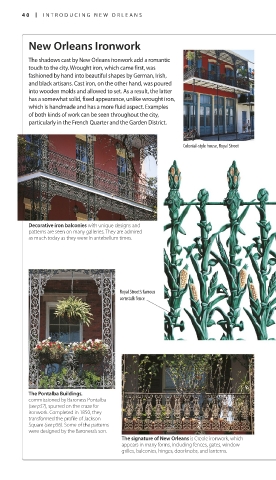
Decorative iron balconies with unique designs and
patterns are seen on many galleries. They are admired
as much today as they were in antebellum times.
Royal Street’s famous
corn stalk fence
The Pontalba Buildings,
commissioned by Baroness Pontalba
(see p57), spurred on the craze for
ironwork. Completed in 1850, they
transformed the profile of Jackson
Square (see p56). Some of the patterns
were designed by the Baroness’s son.
The signature of New Orleans is Creole ironwork, which
appears in many forms, including fences, gates, window
grilles, balconies, hinges, doorknobs, and lanterns.
040-041_EW_New_Orleans.indd 40 13/08/14 2:11 pm

