


Page 47 - History of War - Issue 25-16
P. 47
ROCROI
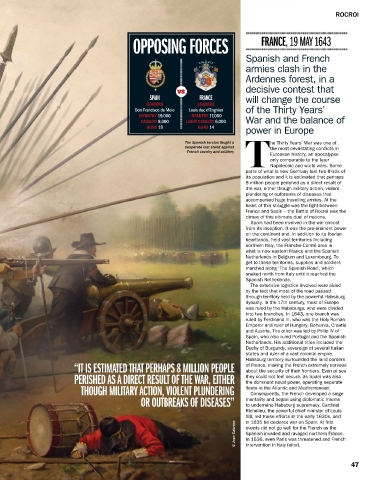
OPPOSINGFORCES FRANCE,19MAY1643
Spanish and French
armies clash in the
Ardennes forest, in a
vs decisive contest that
SPAIN FRANCE will change the course
LEADERS LEADERS
Don Francisco de Melo Louis duc d’Enghien of the Thirty Years’
INFANTRY 19,000 INFANTRY 17,000
CAVALRY 8,000 LIGHT CAVALRY 6,000 War and the balance of
GUNS 18 GUNS 14
power in Europe
The Spanish tercios fought a he Thirty Years’ War was one of
desperate last stand against the most devastating conl icts in
French cavalry and artillery
European history, an apocalypse
only comparable to the later
T Napoleonic and world wars. Some
parts of what is now Germany lost two-thirds of
its population and it is estimated that perhaps
8 million people perished as a direct result of
the war, either though military action, violent
plundering or outbreaks of diseases that
accompanied huge travelling armies. At the
heart of this struggle was the i ght between
France and Spain – the Battle of Rocroi was the
climax of this ultimate duel of nations.
Spain had been involved in the war almost
from its inception. It was the pre-eminent power
on the continent and, in addition to its Iberian
heartlands, held vast territories including
northern Italy, the Franche-Comté area in
what is now eastern France and the Spanish
Netherlands in Belgium and Luxembourg. To
get to these territories, supplies and soldiers
marched along ‘The Spanish Road’, which
snaked north from Italy until it reached the
Spanish Netherlands.
The extensive logistics involved were aided
by the fact that most of the road passed
through territory held by the powerful Habsburg
dynasty. In the 17th century, most of Europe
was ruled by the Habsburgs, who were divided
into two branches. In 1643, one branch was
ruled by Ferdinand III, who was the Holy Roman
Emperor and ruler of Hungary, Bohemia, Croatia
and Austria. The other was led by Philip IV of
Spain, who also ruled Portugal and the Spanish
Netherlands. His additional titles included the
Duchy of Burgundy, sovereign of several Italian
states and ruler of a vast colonial empire.
Habsburg territory surrounded the land borders
“IT IS ESTIMATED THAT PERHAPS 8 MILLION PEOPLE of France, making the French extremely nervous
about the security of their frontiers. Even at sea
PERISHED AS A DIRECT RESULT OF THE WAR, EITHER they could not feel secure, as Spain was also
the dominant naval power, operating separate
THOUGH MILITARY ACTION, VIOLENT PLUNDERING l eets in the Atlantic and Mediterranean.
Consequently, the French developed a siege
OR OUTBREAKS OF DISEASES” mentality and began using diplomatic means
to undermine Habsburg supremacy. Cardinal
Richelieu, the powerful chief minister of Louis
XIII, led these efforts in the early 1630s, and
© Jose Cabrera events did not go well for the French as the
in 1635 he declared war on Spain. At i rst
Spanish invaded and ravaged northern France.
In 1636, even Paris was threatened and French
intervention in Italy failed.
47
47

