


Page 49 - History of War - Issue 25-16
P. 49
ROCROI


                                                                              HOWTHESE MULTI-ROLE UNITS CAME TO
                                                                              DOMINATEEARLYMODERNBATTLEFIELDS

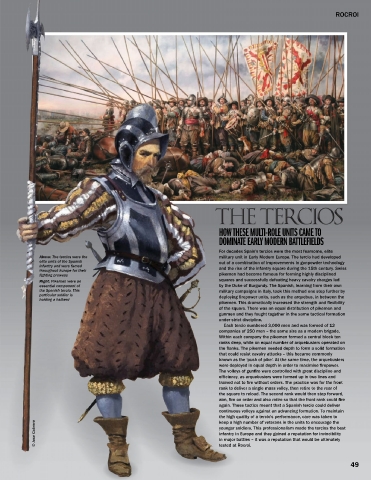
                                                                              For decades Spain’s tercios were the most fearsome, elite
               Above: The tercios were the                                    military unit in Early Modern Europe. The tercio had developed
               elite units of the Spanish                                     out of a combination of improvements in gunpowder technology
               infantry and were famed                                        and the rise of the infantry square during the 15th century. Swiss
               throughout Europe for their
               ighting prowess                                                pikemen had become famous for forming highly disciplined
                                                                              squares and successfully defeating heavy cavalry charges led
               Right: Pikemen were an
               essential component of                                         by the Duke of Burgundy. The Spanish, learning from their own
               the Spanish tercio. This                                       military campaigns in Italy, took this method one step further by
               particular soldier is                                          deploying i repower units, such as the arquebus, in between the
               holding a halberd
                                                                              pikemen. This dramatically increased the strength and l exibility
                                                                              of the square. There was an equal distribution of pikemen and
                                                                              gunmen and they fought together in the same tactical formation
                                                                              under strict discipline.
                                                                                Each tercio numbered 3,000 men and was formed of 12
                                                                              companies of 250 men – the same size as a modern brigade.
                                                                              Within each company the pikemen formed a central block ten
                                                                              ranks deep, while an equal number of arquebusiers operated on
                                                                              the l anks. The pikemen needed depth to form a solid formation
                                                                              that could resist cavalry attacks – this became commonly
                                                                              known as the ‘push of pike’. At the same time, the arquebusiers
                                                                              were deployed in equal depth in order to maximise i repower.
                                                                              The volleys of guni re were controlled with great discipline and
                                                                              efi ciency, as arquebusiers were formed up in two lines and
                                                                              trained not to i re without orders. The practice was for the front
                                                                              rank to deliver a single mass volley, then retire to the rear of
                                                                              the square to reload. The second rank would then step forward,
                                                                              aim, i re on order and also retire so that the front rank could i re
                                                                              again. These tactics meant that a Spanish tercio could deliver
                                                                              continuous volleys against an advancing formation. To maintain
                                                                              the high quality of a tercio’s performance, care was taken to
             © Jose Cabrera                                                   younger soldiers. This professionalism made the tercios the best
                                                                              keep a high number of veterans in the units to encourage the
                                                                              infantry in Europe and they gained a reputation for invincibility
                                                                              in major battles – it was a reputation that would be ultimately
                                                                              tested at Rocroi.


                                                                                                                            49

