


Page 52 - History of War - Issue 25-16
P. 52
GREAT BATTLES


           Louis, duc d’Enghien was 21
           years old at Rocroi and had never
           commanded an army before


                                                                                     up from the rear and blocked the charge of the
                                                                                     German-Croats.
                                                                                      Having saved his infantry, Enghien decided to
                                                                                     seize the initiative by launching his entire right
                                                                                     wing in a great cavalry charge to strike the l ank
                                                                                     and rear of the Spanish infantry. It was a daring
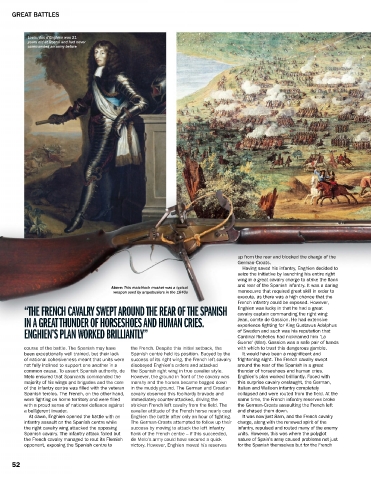
                                        Above: This matchlock musket was a typical
                                         weapon used by arquebusiers in the 1640s    manoeuvre that required great skill in order to
                                                                                     execute, as there was a high chance that the
                                                                                     French infantry could be exposed. However,
                                                                                     Enghien was lucky in that he had a great
                                                                                     cavalry captain commanding the right wing:
                                                                                     Jean, comte de Gassion. He had extensive
                                                                                     experience i ghting for King Gustavus Adolphus
                                                                                     of Sweden and such was his reputation that
                                                                                     Cardinal Richelieu had nicknamed him ‘La
                                                                                     Guerre’ (War). Gassion was a safe pair of hands
          cour                                                                       with which to trust this dangerous gamble.
          been ex                                                                     It would have been a magnii cent and
          of nationa                                                                 frightening sight. The French cavalry swept
          not fully inclin                                                           around the rear of the Spanish in a great
          common cause.                                                              thunder of horseshoes and human cries.
          Melo ensured that                                                          Enghien’s plan worked brilliantly. Faced with
          majority of his wings                                                      this surprise cavalry onslaught, the German,
          of the infantry centre was                                                 Italian and Walloon infantry completely
          Spanish tercios. The French,                                               collapsed and were routed from the i eld. At the
          were ighting on home territory                                             same time, the French infantry reserves broke
          with a proud sense of national dei                                         the German-Croats assaulting the French left
          a belligerent invader.                                                     and chased them down.
           At dawn, Enghien opened the battle                                         It was now just 8am, and the French cavalry
          infantry assault on the Spanish centre whil                                charge, along with the renewed spirit of the
          the right cavalry wing attacked the opposing                               infantry, repulsed and routed many of the enemy
          Spanish cavalry. The infantry attack failed but                            units. However, this was where the polyglot
          the French cavalry managed to rout its Flemish  d                          nature of Spain’s army caused problems not just
          opponent, exposing the Spanish centre to  vict                             for the Spanish themselves but for the French


     52

