


Page 10 - BBC Wildlife Volume 36 #12
P. 10
WILDDECEMBER


             5 | GREAT BLACK-BACKED GULL
             Brute force


             Easily larger than a buzzard, with a
             whopping, meat-cleaver bill, this is our
             most impressive gull. But it could do with
             a few more friends – pinching food from
             hapless cormorants, or wolfing down
             defenceless puffins, is not a good look.
             During summer, great black-backs are
             thinly spread around our coasts. So, it’s
             in winter, when many birds move inland
             and visiting migrants swell the population
             threefold, that you’re most likely to spot
             these gulls. One place they love is landfill
             sites, and nature writer Tim Dee explores
             this in his new book, Landfill.


             TOP TIP Watch an identification video
             at bto.org/about-birds/bird-id


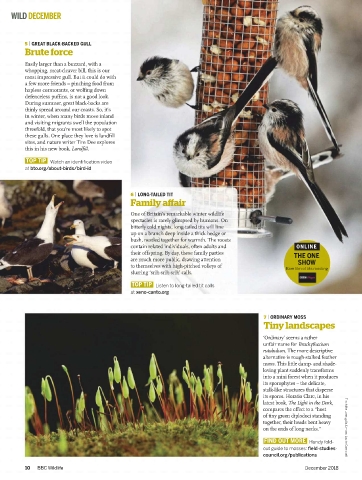
                                                             6 | LONG-TAILED TIT
                                                             Family afair


                                                             One of Britain’s remarkable winter wildlife
                                                             spectacles is rarely glimpsed by humans. On
                                                             bitterly cold nights, long-tailed tits will line
                                                             up on a branch deep inside a thick hedge or
                                                             bush, nestled together for warmth. The roosts
                                                             contain related individuals, often adults and                                ONLINE
                                                             their offspring. By day, these family parties
                                                             are much more public, drawing attention                                     THE ONE
                                                             to themselves with high-pitched volleys of                                   SHOW
                                                                                                                                     Rare film of tits roosting
                                                             slurring ‘srih-srih-srih’ calls.


                                                              TOP TIP Listen to long-tailed tit calls
                                                             at xeno-canto.org


                                                                                                                           7 | ORDINARY MOSS
                                                                                                                           Tiny landscapes

                                                                                                                          ‘Ordinary’ seems a rather
                                                                                                                          unfair name for Brachythecium
                                                                                                                          rutabulum. The more descriptive
                                                                                                                          alternative is rough-stalked feather
                                                                                                                          moss. This little damp- and shade-
                                                                                                                          loving plant suddenly transforms
                                                                                                                          into a mini forest when it produces
                                                                                                                          its sporophytes – the delicate,
                                                                                                                          stalk-like structures that disperse
                                                                                                                          its spores. Horatio Clare, in his
                                                                                                                          latest book, The Light in the Dark,
                                                                                                                          compares the effect to a “host
                                                                                                                          of tiny green diplodoci standing
                                                                                                                          together, their heads bent heavy
                                                                                                                          on the ends of long necks.”           Tits: Mike Lane; gulls & moss: Laurie Campbell


                                                                                                                           FIND OUT MORE Handy fold-
                                                                                                                          out guide to mosses: field-studies-
                                                                                                                          council.org/publications


             10   BBC Wildlife                                                                                                                December 2018

