


Page 13 - BBC Wildlife Volume 36 #12
P. 13
WILD DECEMBER


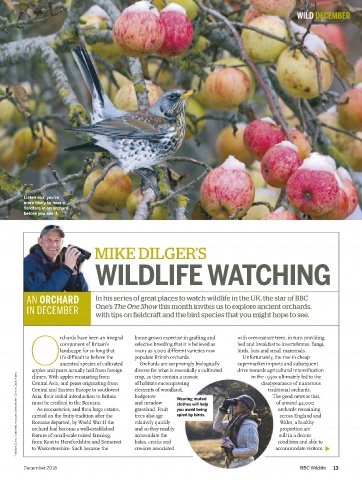
            Listen out: you’re
            more likely to hear a
            fieldfare in an orchard
            before you see it.


                                             MIKE DILGER’S


                                             WILDLIFEWATCHING


             AN ORCHARD                      In his series of great places to watch wildlife in the UK, the star of BBC

             IN DECEMBER                     One’s The One Show this month invites us to explore ancient orchards,
                                             with tips on ieldcrat and the bird species that you might hope to see.


                             rchards have been an integral     home-grown expertise in grafting and            with over-mature trees, in turn providing
                             component of Britain’s            selective breeding that it is believed as       bed and breakfast to invertebrates, fungi,
                             landscape for so long that        many as 3,000 different varieties now           birds, bats and small mammals.
                             it’s difficult to believe the      populate British orchards.                        Unfortunately, the rise in cheap
               Oancestral species of cultivated                  Orchards are surprisingly biologically        supermarket imports and subsequent
                apples and pears actually hail from foreign    diverse for what is essentially a cultivated    drive towards agricultural intensification
         Fieldfare: David Kjaer/naturepl.com; birdwatcher: Simon Dack/Alamy
                climes. With apples emanating from             crop, as they contain a mosaic                        in the 1950s ultimately led to the
                Central Asia, and pears originating from       of habitats encompassing                                   disappearance of numerous
                Central and Eastern Europe to southwest        elements of woodland,                                         traditional orchards.
                Asia, their initial introduction to Britain    hedgerow            Wearing muted                               The good news is that,
                must be credited to the Romans.                and meadow          clothes will help                            of around 42,000
                  As monasteries, and then large estates,      grassland. Fruit    you avoid being                               orchards remaining
                carried on the fruity tradition after the      trees also age      spied by birds.                                across England and
                Romans departed, by World War II the           relatively quickly                                                 Wales, a healthy
                orchard had become a well-established          and so they readily                                                proportion are
                feature of small-scale mixed farming,          accumulate the                                                     still in a decent
                from Kent to Herefordshire and Somerset        holes, cracks and                                                 condition and able to
                to Worcestershire. Such became the             crevices associated                                              accommodate visitors.


            December 2018                                                                                                                  BBC Wildlife    13

