


Page 14 - BBC Wildlife Volume 36 #12
P. 14
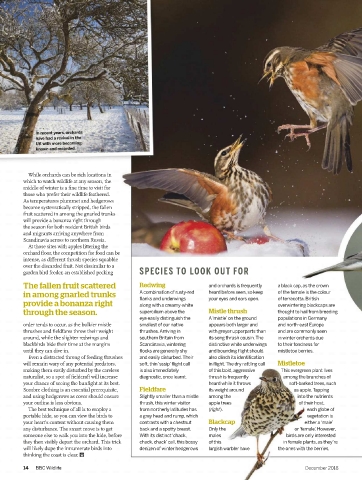
In recent years, orchards
                  have had a revival in the
                  UK with more becoming
                  known and recorded.


              While orchards can be rich locations in
            which to watch wildlife at any season, the
            middle of winter is a fine time to visit for
            those who prefer their wildlife feathered.
            As temperatures plummet and hedgerows
            become systematically stripped, the fallen
            fruit scattered in among the gnarled trunks
            will provide a bonanza right through
            the season for both resident British birds
            and migrants arriving anywhere from
            Scandinavia across to northern Russia.
              At those sites with apples littering the
            orchard floor, the competition for food can be
            intense, as different thrush species squabble
            over the discarded fruit. Not dissimilar to a
            garden bird feeder, an established pecking           SPECIES          TO     LOOK       OUT      FOR

            The fallen fruit scattered                           Redwing                         and orchards is frequently      a black cap, as the crown

            in among gnarled trunks                              A combination of rusty-red      heard before seen, so keep      of the female is the colour
                                                                 flanks and underwings            your eyes and ears open.        of terracotta. British
            provide a bonanza right                              along with a creamy-white                                       overwintering blackcaps are

            through the season.                                  supercilium above the           Mistle thrush                   thought to hail from breeding
                                                                 eye easily distinguish the      A ‘mistle’ on the ground        populations in Germany
            order tends to occur, as the bulkier mistle          smallest of our native          appears both larger and         and north-east Europe
            thrushes and fieldfares throw their weight            thrushes. Arriving in           with greyer upperparts than     and are commonly seen
            around, while the slighter redwings and              southern Britain from           its song thrush cousin. The     in winter orchards due
            blackbirds bide their time at the margins            Scandinavia, wintering          distinctive white underwings    to their fondness for
            until they can dive in.                              flocks are generally shy         and bounding flight should       mistletoe berries.
              Even a distracted throng of feeding thrushes       and easily disturbed. Their     also clinch its identification
            will remain wary of any potential predators,         soft, thin ‘sssip’ flight call    in flight. The dry rattling call   Mistletoe
            making them easily disturbed by the careless         is also immediately             of this bold,aggressive           This evergreen plant lives
            naturalist, so a spot of fieldcraft will increase     diagnostic, once learnt.        thrush is frequently               among the branches of
            your chance of seeing the bunfight at its best.                                       heard while it throws                soft-barked trees, such
            Sombre clothing is an essential prerequisite,        Fieldfare                       its weight around                       as apple. Tapping
            and using hedgerows as cover should ensure           Slightly smaller than a mistle   among the                               into the nutrients
            your outline is less obvious.                        thrush, this winter visitor     apple trees                               of their host,
              The best technique of all is to employ a           from northerly latitudes has    (right).                                      each globe of
            portable hide, so you can view the birds to          a grey head and rump, which                                                   vegetation is
            your heart’s content without causing them            contrasts with a chestnut       Blackcap                                     either a ‘male’
            any disturbance. The smart move is to get            back and a spotty breast.       Only the                                or‘female’. However,
            someone else to walk you into the hide, before       With its distinct ‘chack,       males                               birds are only interested
            they then visibly depart the orchard. This trick     chack, chack’ call, this bossy   of this                           in female plants, as they’re
            will likely dupe the innumerate birds into           denizen of winter hedgerows     largish warbler have            the ones with the berries.
            thinking the coast is clear.


            14    BBC Wildlife                                                                                                                December 2018

