Page 102 - BBC Wildlife Volume 36 #12
P. 102
OURWILD WORLD


                                                                                                                    ARACHNIDS
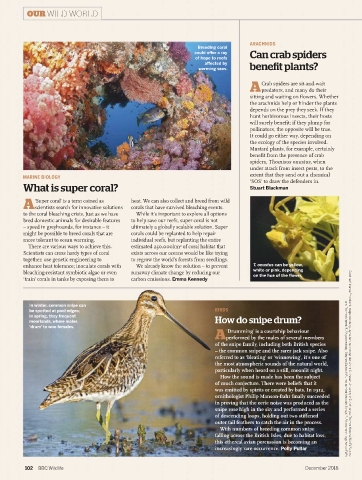
                                                                                            Breeding coral
                                                                                           could ofer a ray         Cancrabspiders
                                                                                           of hope to reefs
                                                                                               afected by
                                                                                             warming seas.          beneit plants?


                                                                                                                          Crab spiders are sit-and-wait
                                                                                                                    Apredators, and many do their
                                                                                                                    sitting and waiting on flowers. Whether
                                                                                                                    the arachnids help or hinder the plants
                                                                                                                    depends on the prey they seek. If they
                                                                                                                    hunt herbivorous insects, their hosts
                                                                                                                    will surely benefit; if they plump for
                                                                                                                    pollinators, the opposite will be true.
                                                                                                                    It could go either way, depending on
                                                                                                                    the ecology of the species involved.
                                                                                                                    Mustard plants, for example, certainly
                                                                                                                    benefit from the presence of crab
                                                                                                                    spiders, Thomisus onustus, when
                                                                                                                    under attack from insect pests, to the
                                                                                                                    extent that they send out a chemical
            MARINE BIOLOGY
                                                                                                                    ‘SOS’ to draw the defenders in.
            What is super coral?                                                                                    Stuart Blackman


                 ‘Super coral’ is a term coined as            heat. We can also collect and breed from wild
            Ascientists search for innovative solutions       corals that have survived bleaching events.
            to the coral bleaching crisis. Just as we have      While it’s important to explore all options
            bred domestic animals for desirable features      to help save our reefs, super coral is not
            – speed in greyhounds, for instance – it          ultimately a globally scalable solution. Super
            might be possible to breed corals that are        corals could be replanted to help repair
            more tolerant to ocean warming.                   individual reefs, but replanting the entire
                                                                                    2
              There are various ways to achieve this.         estimated 250,000km of coral habitat that
            Scientists can cross hardy types of coral         exists across our oceans would be like trying
            together; use genetic engineering to              to regrow the world’s forests from seedlings.
            enhance heat tolerance; inoculate corals with       We already know the solution – to prevent             T. onustus can be yellow,
                                                                                                                      white or pink, depending
            bleaching-resistant symbiotic algae or even       runaway climate change by reducing our                  on the hue of the flower.
            ‘train’ corals in tanks by exposing them to       carbon emissions. Emma Kennedy                                                                      Coral reef: Marine Photobank


               In winter, common snipe can
               be spotted at pool edges;                                                            BIRDS
               in spring, they frequent
               moorlands, where males                                                               How do snipe drum?
               ‘drum’ to woo females.
                                                                                                         'Drumming’ is a courtship behaviour
                                                                                                    Aperformed by the males of several members
                                                                                                    of the snipe family, including both British species
                                                                                                    – the common snipe and the rarer jack snipe. Also
                                                                                                    referred to as ‘bleating’ or ‘winnowing’, it's one of
                                                                                                    the most atmospheric sounds of the natural world,
                                                                                                    particularly when heard on a still, moonlit night.
                                                                                                       How the sound is made has been the subject               loris: Thomas Marent/FLPA; painted lady: Stephen Dalton/NPL; red admiral: Malcolm Schuyl/FLPA; monarch: Ingo Arndt/FLPA
                                                                                                    of much conjecture. There were beliefs that it                mage prov de by Jayne Jenk ns; crab sp der: An na C. Knauer, Un vers ty of Zur ch; sn pe: Thomas H nsche BIA/FLPA; s ow
                                                                                                    was emitted by spirits or created by bats. In 1912,
                                                                                                    ornithologist Philip Manson-Bahr finally succeeded
                                                                                                    in proving that the eerie noise was produced as the
                                                                                                    snipe rose high in the sky and performed a series
                                                                                                    of descending loops, holding out two stiffened
                                                                                                    outer tail feathers to catch the air in the process.
                                                                                                       With numbers of breeding common snipe
                                                                                                    falling across the British Isles, due to habitat loss,
                                                                                                    this ethereal avian percussion is becoming an
                                                                                                    increasingly rare occurrence. Polly Pullar


             102   BBC Wildlife                                                                                                               December 2018
   97   98   99   100   101   102   103   104   105   106   107