


Page 104 - BBC Wildlife Volume 36 #12
P. 104
OURWILD WORLD


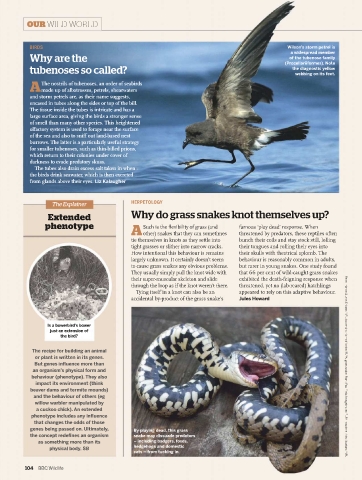
               BIRDS                                                                                                                  Wilson's storm petrel is
                                                                                                                                       a widespread member
               Why are the                                                                                                             of the tubenose family
                                                                                                                                    (Procellariiformes). Note
               tubenoses so called?                                                                                                     the diagnostic yellow
                                                                                                                                         webbing on its feet.
                    The nostrils of tubenoses, an order of seabirds
               Amade up of albatrosses, petrels, shearwaters
               and storm petrels are, as their name suggests,
               encased in tubes along the sides or top of the bill.
               The tissue inside the tubes is intricate and has a
               large surface area, giving the birds a stronger sense
               of smell than many other species. This heightened
               olfactory system is used to forage near the surface
               of the sea and also to sniff out land-based nest
               burrows. The latter is a particularly useful strategy
               for smaller tubenoses, such as thin-billed prions,
               which return to their colonies under cover of
               darkness to evade predatory skuas.
                 The tubes also drain excess salt taken in when
               the birds drink seawater, which is then excreted
               from glands above their eyes. Liz Kalaugher


                         The Explainer                        HERPETOLOGY


                       Extended                               Why do grass snakes knot themselves up?
                      phenotype                                    Such is the flexibility of grass (and        famous ‘play dead’ response. When
                                                              A other) snakes that they can sometimes          threatened by predators, these reptiles often
                                                              tie themselves in knots as they settle into      bunch their coils and stay stock still, lolling
                                                              tight grasses or slither into narrow cracks.     their tongues and rolling their eyes into
                                                              How intentional this behaviour is remains        their skulls with theatrical aplomb. The
                                                              largely unknown. It certainly doesn’t seem       behaviour is reasonably common in adults,
                                                              to cause grass snakes any obvious problems.      but rarer in young snakes. One study found
                                                              They usually simply pull the knot wide with      that 66 per cent of wild-caught grass snakes
                                                              their super-muscular skeleton and slide          exhibited the death-feigning response when
                                                              through the loop as if the knot weren’t there.   threatened, yet no (lab-reared) hatchlings
                                                                Tying itself in a knot can also be an          appeared to rely on this adaptive behaviour.
                                                              accidental by-product of the grass snake’s       Jules Howard


                       Is a bowerbird's bower
                        just an extension of
                             the bird?


                The recipe for building an animal
                 or plant is written in its genes.
                 But genes influence more than
                an organism’s physical form and                                                                                                                 Petre : Hanne & Jens Eriksen/NPL; bowerbird: Konrad Wothe/FLPA; grass snake: Frank Paul Fietz/Imagebroker/FLPA; mackerel: Alex Mustard/NPL
                behaviour (phenotype). They also
                 impact its environment (think
               beaver dams and termite mounds)
                 and the behaviour of others (eg
                 willow warbler manipulated by
                  a cuckoo chick). An extended
               phenotype includes any influence
                 that changes the odds of those
               genes being passed on. Ultimately,              By playing dead, this grass
               the concept redefines an organism                snake may dissuade predators
                   as something more than its                  – including badgers, foxes,
                                                               hedgehogs and domestic
                        physical body. SB
                                                               cats – from tucking in.


             104   BBC Wildlife

