


Page 103 - BBC Wildlife Volume 36 #12
P. 103
OURWILD WORLD
3 questions on
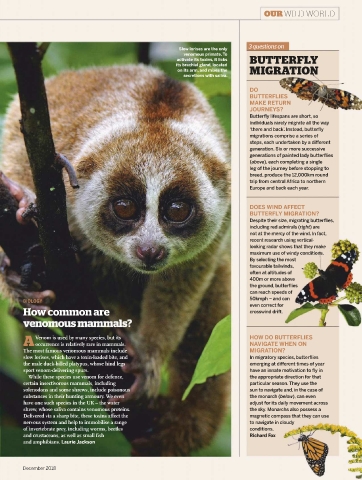
Slow lorises are the only
venomous primate. To
activate its toxins, it licks BUTTERFLY
its brachial gland, located
on its arm, and mixes the MIGRATION
secretions with saliva.
DO
BUTTERFLIES
MAKE RETURN
JOURNEYS?
Butterfly lifespans are short, so
individuals rarely migrate all the way
‘there and back’. Instead, butterfly
migrations comprise a series of
steps, each undertaken by a diferent
generation. Six or more successive
generations of painted lady butterflies
(above), each completing a single
leg of the journey before stopping to
breed, produce the 12,000km round
trip from central Africa to northern
Europe and back each year.
DOES WIND AFFECT
BUTTERFLY MIGRATION?
Despite their size, migrating butterflies,
including red admirals (right) are
not at the mercy of the wind. In fact,
recent research using vertical-
looking radar shows that they make
maximum use of windy conditions.
By selecting the most
favourable tailwinds,
often at altitudes of
400m or more above
the ground, butterflies
can reach speeds of
50kmph – and can
BIOLOGY
even correct for
How common are crosswind drift.
l
Venom is used by many species, but its HOW DO BUTTERFLIES
A occurrence is relatively rare in mammals. NAVIGATE WHEN ON
The most famous venomous mammals include MIGRATION?
slow lorises, which have a toxin-loaded bite, and In migratory species, butterflies
the male duck-billed platypus, whose hind legs emerging at diferent times of year
sport venom-delivering spurs. have an innate motivation to fly in
While these species use venom for defence, the appropriate direction for that
certain insectivorous mammals, including particular season. They use the
solenodons and some shrews, include poisonous sun to navigate and, in the case of
substances in their hunting armoury. We even the monarch (below), can even
have one such species in the UK – the water adjust for its daily movement across
shrew, whose saliva contains venomous proteins. the sky. Monarchs also possess a
Delivered via a sharp bite, these toxins affect the magnetic compass that they can use
nervous system and help to immobilise a range to navigate in cloudy
of invertebrate prey, including worms, beetles conditions.
and crustaceans, as well as small fish Richard Fox
and amphibians. Laurie Jackson
December 2018

