


Page 30 - BBC Wildlife Volume 36 #12
P. 30
Talking

        point


            humour can undermine the seriousness
            of the message that our planet is in trouble.
            A recent blog on the website Scientific
            American, by Catherine Brooks, argued
            that by chasing popularity and ‘likes’
            on social media, the credibility of any
            scientific message is lost.
               But we know that negative messaging
            does not work. People are less likely to
            retain information given this way, and
            more likely to feel that any action they do
            take is pointless. This can be countered
            by adopting a more positive approach,
            such as highlighting positive conservation
            stories. It’s a trend strongly encouraged by
            the Conservation Optimism movement,
            which inspired BBC Wildlife's 'Good news!'
            feature in Spring 2017. On the other hand,
            too many overly positive stories might
            encourage people to feel everything is okay.
               Back in 2012, biologist Simon Watt
            dreamed up The Ugly Animal Preservation
            Society to raise awareness of some obscure
            and aesthetically challenged species. It led
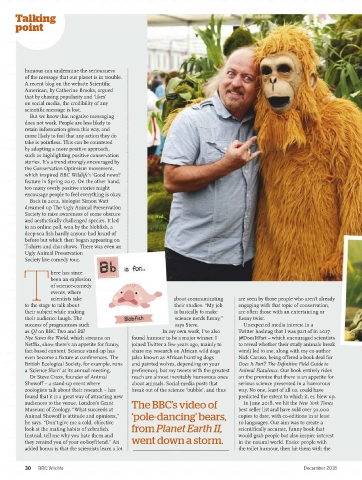
            to an online poll, won by the blobfish, a
            deep-sea fish hardly anyone had heard of
            before but which then began appearing on
            T-shirts and chat shows. There was even an
            Ugly Animal Preservation
            Society live comedy tour.


                        here has since
                        been an explosion
                        of science-comedy
                        events, where
            T scientists take                                                    about communicating           are seen by those people who aren’t already
            to the stage to talk about                                           their studies. “My job        engaging with that topic of conservation,
            their subject while making                                           is basically to make          are often those with an entertaining or
            their audience laugh. The                                             science nerds funny,”        funny twist.
            success of programmes such                                            says Steve.                    Unexpected media interest in a
            as QI on BBC Two and Bill                                       In my own work, I’ve also          Twitter hashtag that I was part of in 2017
            Nye Saves the World, which streams on             found humour to be a major winner. I             (#DoesItFart – which encouraged scientists
            Netflix, show there’s an appetite for funny,       joined Twitter a few years ago, mainly to        to reveal whether their study animals break
            fact-based content. Science stand-up has          share my research on African wild dogs           wind) led to me, along with my co-author
            even become a fixture at conferences. The          (also known as African hunting dogs              Nick Caruso, being offered a book deal for
            British Ecological Society, for example, runs     and painted wolves, depending on your            Does It Fart? The Definitive Field Guide to
            a ‘Science Slam’ at its annual meeting.           preference), but my tweets with the greatest     Animal Flatulence. Our book entirely rides
               Dr Steve Cross, founder of Animal              reach are almost inevitably humorous ones        on the premise that there is an appetite for
            Showoff – a stand-up event where                  about animals. Social-media posts that           serious science presented in a humorous
            zoologists talk about their research – has        break out of the science ‘bubble’, and thus      way. No one, least of all us, could have
            found that it is a great way of attracting new                                                     predicted the extent to which it, er, blew up.
            audiences to the venue, London’s Grant            The BBC’s video of                                 In June 2018, we hit the New York Times
            Museum of Zoology. “What succeeds at                                                               best seller list and have sold over 50,000
            Animal Showoff is attitude and opinions,”         ‘pole-dancing’ bears,                            copies to date, with co-editions in at least
            he says. “Don’t give me a cold, objective                                                          10 languages. Our aim was to create a
            look at the mating habits of zebrafish.            from Planet Earth II,                            scientifically accurate, funny book that
            Instead, tell me why you hate them and                                                             would grab people but also inspire interest
            they remind you of your ex-boyfriend.” An         went down a storm.                               in the natural world. Entice people with
            added bonus is that the scientists learn a lot                                                     the toilet humour, then hit them with the


             30    BBC Wildlife                                                                                                              December 2018

