


Page 33 - History of War - Issue 05-14
P. 33
AFTER D-DAY


             BLOODBATH


                      IN

                   THE         BOCAGE


                   Second World War:                       LLIED PLANNERS HAD   of Caen, the country was open – but too   BA CKST OR Y
                                                                                                                   BACKSTORY
                   For all the heroics of                  spent so much time   open. Here, Capriquet airfield extended   With the war in
                                                                                                                   With the war in
                                                                                east to west across any advance to the
                                                                                                                   its fifth year, the

                   D-Day, there was still                  solving the problems of   south the Canadian 3rd Division might   Allies had taken the
                                                           getting troops ashore
                a long way to go before                    on D-Day that virtually   make, and the Germans were busily   initiative, invading
                                                                                                                   France en masse
                                                                                defending the southern side of the
                        the Allies’ overall                no attention had been   runway. Further west, the British on Gold   with the intention
                                                           paid to the problems
                                                                                                                   of driving out the
                  objective was met. As        they might encounter once they were   Beach, and the Americans on Omaha   German occupiers
                                                                                and Utah, faced very different problems.
                 Bernard Montgomery’s          off the beaches. The soldiers had                                   and, ultimately,
                                               trained in large armoured formations
                                                                                                                   forcing a surrender
                forces battled their way       on Salisbury Plain, Dartmoor, Exmoor   Massive force                by the Axis forces.
                    across Normandy in         and the North York Moors, preparing   From Capriquet, and extending to the
                                                                                marshes of the Cotentin Peninsula,
                                               for the type of mobile warfare that had
                   an attempt to retake        characterised operations in North Africa.   lay the bocage, a patchwork of sunken
                    occupied towns and         On the extreme left of the beachhead,   lanes and fields bounded by ancient
                                               6th Airborne had established a small
                                                                                hedgerows that rose to a height of 15
                   cities, they were met       bridgehead across the Orne, overlooking   feet. Farmhouses studded the land, their
                  with fierce opposition.       country not unlike that of Salisbury Plain.   thick-walled buildings relics of the time,
                                                                                five centuries earlier, when Normandy
                                               However, the bridgehead was considered
                       And nowhere was         too small to allow armoured divisions to   had been a battleground during the

                        this more deadly       concentrate there in any strength, and   Hundred Years War. Ten miles inland,

                                                                                the country rose to a tangle of hills that
                                               certainly not in secret. To the immediate
                 than in the unforgiving       west, the situation was even worse.   the Normans called “Normandie Suisse”
                         bocage region…        Here, the British 3rd Division faced the   because of its resemblance to the
                                                                                Alpine foothills. In short, the Normandy
                                               industrial suburbs of Caen, which the
                                               Germans were defending. All armies   countryside was an attacker’s nightmare
                                               disliked attacking into cities, because it   and a defender’s paradise; a network
                                               was bloody and took time. To the west    of natural and man-made obstacles.
                                                                                  Erwin Rommel knew that if the
                                                                                beachhead was to be destroyed, it must
                                                                                be attacked quickly and with massive
                                                                                force. He ordered the 21st Panzer
                                                                                and 12th SS Panzer Divisions to strike
                                                                                a coordinated blow, but both were
                                                                                already fighting piecemeal with the
                                                                                Allies and could not disengage. By dawn

                                                                              THE NORMANDY

                                                                              COUNTRYSIDE

                                                                              WAS SEEN AS

                                                                              AN ATTACKER'S

                                                                                NIGHTMARE AND
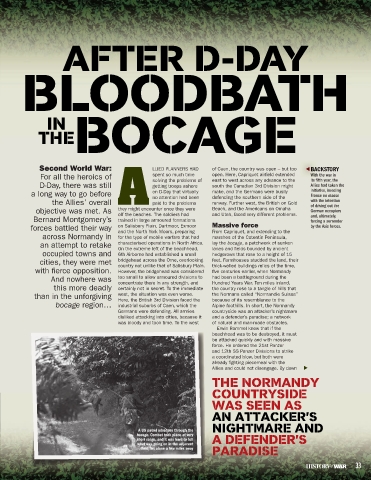
                                                      A US patrol advances through the
                                                     bocage. Combat took place at very
                                                     short range, and it was hard to tell     A DEFENDER'S
                                                      what was going on in the adjacent
                                                       field, let alone a few miles away     PARADISE
                                                                                                                 HISTORY  WAR    33
                                                                                                                         of

