


Page 37 - History of War - Issue 05-14
P. 37
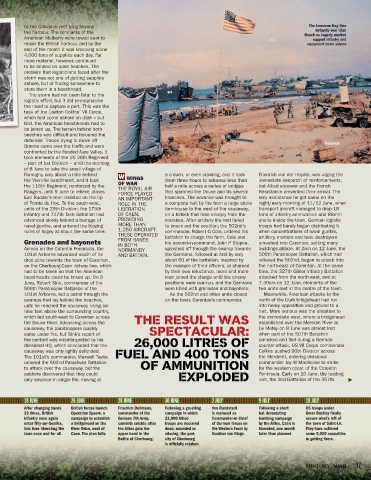
by the Calvados reef lying beyond                                                                   The American flag flies
                                                                                                                    defiantly over Utah
              the harbour. The remnants of the                                                                  Beach as eagerly awaited
              American Mulberry were towed east to                                                                 support infantry and
              repair the British harbour, and by the                                                             equipment come ashore
              end of the month it was receiving some
              4,000 tons of supplies each day. Far
              more materiel, however, continued
              to be landed on open beaches. The
              problem that logisticians faced after the
              storm was not one of getting supplies
              ashore, but of finding somewhere to
              store them in a beachhead.
               The storm had not been fatal to the
              logistic effort, but it did re-emphasise
              the need to capture a port. This was the
              task of Joe Lawton Collins’ VII Corps,
              which had come ashore on Utah – but
              first, the American beachheads had to
              be joined up. The terrain behind both
              beaches was difficult and favoured the
              defender. Troops trying to move off                                                                       Xxxxxxxxx
              Omaha came over the bluffs and were
              confronted by the flooded Aure Valley. It
              took elements of the US 26th Regiment
              – part of 1st Division – until the morning
              of 8 June to take the small village of
              Formigny, only about a mile behind               a crouch, or even crawling, and it took   Friedrich von der Heydte, was urging the
              the Vierville beachhead, and it took   w  WINGS    them three hours to advance less than   immediate despatch of reinforcements,
              the 116th Regiment, reinforced by the   OF WAR    half a mile across a series of bridges   but Allied airpower and the French
                                               THE ROYAL AIR
              Rangers, until 9 June to relieve James   FORCE PLAYED   that spanned the Douve and its several   Resistance prevented their arrival. The
              Earl Rudder’s men isolated on the tip    AN IMPORTANT   branches. The advance was brought to    only assistance he got came on the
              of Pointe du Hoc. To the south-west,   ROLE IN THE   a complete halt by fire from a large stone   night/early morning of 11/12 June, when
              units of the 29th Division, the 175th   LIBERATION   farmhouse to the west of the causeway,   transport aircraft managed to drop 18
              Infantry and 747th Tank Battalion had   OF CAEN,   on a hillock that rose sharply from the   tons of infantry ammunition and 88mm
              advanced slowly behind a barrage of   PROVIDING    marshes. After artillery fire had failed   shells inside the town. German logistic
              naval gunfire, and entered the blazing   MORE THAN   to knock out the position, the 502nd’s   troops had barely begun distributing it
              ruins of Isigny at about the same time.  1,250 AIRCRAFT.   commander, Robert G Cole, ordered his   when concentrations of naval gunfire,
                                               THESE OPERATED   battalion to charge the farm. Cole and   artillery, mortars and tank destroyers
              Grenades and bayonets            FROM BASES      his second-in-command, John P Stopka,   smashed into Carentan, setting many
                                               IN BOTH
              Across on the Cotentin Peninsula, the   NORMANDY    splashed off through the swamp towards   buildings ablaze. At 2am on 12 June, the
              101st Airborne advanced south of its   AND BRITAIN.  the Germans, followed at first by only   506th Paratrooper Battalion, which had
              drop zone towards the town of Carentan,          about 60 of the battalion. Inspired by   relieved the 502nd, began to attack into
              on the Cherbourg-Caen railway line, which        the example of their officers, or shamed   the north-east of Carentan. At the same
              had to be taken so that the American             by their own reluctance, more and more   time, the 327th Glider Infantry Battalion
              beachheads could be linked up. On 9              men joined the charge until the enemy   attacked from the north-west, and at
              June, Robert Sink, commander of the              positions were overrun, and the Germans   7.30am on 12 June, elements of the
              506th Paratrooper Battalion of the               were killed with grenades and bayonets.   two units met in the centre of the town.
              101st Airborne, led a patrol through the           As the 502nd and other units closed   Meanwhile, American attacks to the
              swamps that lay behind the beaches,              on the town, Carentan’s commander,   north of the Utah bridgehead had run
              until he reached the causeway rising six-                                         into heavy opposition and ground to a
              nine feet above the surrounding country,                                          halt. More serious was the situation to
              which led south-west to Carentan across   THE RESULT WAS                          the immediate west, where a bridgehead
              the Douve River. Advancing across the                                             established over the Meredet River at
              causeway, the paratroopers quickly          SPECTACULAR:                          Le Motey on 8 June was almost lost
              came under fire, but Sink’s report of                                              when part of the 507th Battalion
              the contact was misinterpreted by his   26,000 LITRES OF                          panicked and fled during a German
              divisional HQ, which concluded that the                                           counter-attack. US VII Corps commander
              The 101st’s commander, Maxwell Taylor,  FUEL AND 400 TONS                         Collins pushed 90th Division across
              causeway was only lightly defended.
                                                                                                the Merderet, ordering divisional
              ordered the 502nd Parachute Battalion    OF AMMUNITION                            commander Jay W MacKelvie to strike
              to attack over the causeway, but the                                              for the western coast of the Cotentin
              soldiers discovered that they could                   EXPLODED                    Peninsula. Early on 10 June, the leading
              only advance in single file, moving at                                             unit, the 2nd Battalion of the 357th


              18 JUNE         26 JUNE          28 JUNE         30 JUNE          2 JULY          9 JULY           18 JULY
              After changing hands   British forces launch   Friedrich Dollmann,   Following a gruelling   Von Rundstedt   Following a short    US troops under
              23 times, British   Operation Epsom, a   commander of the   campaign in which   is replaced as   but devastating   Omar Bradley finally
              infantry once again   campaign to establish   German 7th Army,   23,000 Allied    Commander-in-Chief    bombing campaign   secure what’s left of
              enter Tilly-sur-Seulles,   a bridgehead on the   commits suicide after   troops are declared   of German forces on   by the Allies, Caen is   the town of Saint-Lô.
              this time liberating the    River Odon, west of   the Allies gain the   dead, wounded or   the Western Front by   liberated, one month   They have suffered
              town once and for all.  Caen. The plan fails.  upper hand in the   missing, the port    Gunther von Kluge.  later than planned.  some 5,000 casualties
                                               Battle of Cherbourg.  city of Cherbourg                           in getting there.
                                                               is officially retaken.


                                                                                                                 HISTORY  WAR    37
                                                                                                                         of

