


Page 36 - History of War - Issue 05-14
P. 36
BLOODBATH IN THE BOCAGE

             the regimental Sergeant Major. Reaching
             the town square, Wittmann was hit by a
             storm of British anti-tank fire, and pulled
             back, destroying yet another British
             tank in the process. After re-arming
             and re-fuelling, and joining up with four
             other Tigers and an up-gunned Mark VI,
             he returned to Point 213 to complete
             the massacre of the County of London
             Yeomanry. Then, reinforced by some
             tanks from 2nd Panzer Division, he
             again attacked into Villers-Bocage. This
             time, the British were ready and the
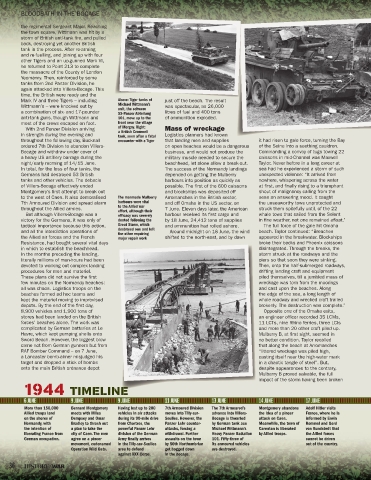
             Mark IV and three Tigers – including   Above: Tiger tanks of   just off the beach. The result
             Wittmann’s – were knocked out by    Michael Wittmann’s    was spectacular, as 26,000
                                               unit, the schwere
             a combination of six- and 17-pounder    SS-Panzer Abteilung   litres of fuel and 400 tons
             anti-tank guns, though Wittmann and   101, move up to the   of ammunition exploded.
             most of the crews escaped on foot.   front near the village
              With 2nd Panzer Division arriving   of Morgny. Right:    Mass of wreckage
             in strength during the evening and   a British Cromwell   Logistics planners had known
                                               tank, seen after a fatal
             throughout the following day, Bucknall   encounter with a Tiger  that landing men and supplies   it had risen to gale force, turning the Bay
             ordered 7th Division to abandon Villers-          on open beaches would be a dangerous   of the Seine into a seething cauldron.
             Bocage and withdraw under cover of                business, and would not produce the   Commanding a convoy of tugs towing 22
             a heavy US artillery barrage during the           military muscle needed to secure the   caissons in mid-Channel was Maxwell
             night/early morning of 14/15 June.                beachhead, let alone allow a break-out.   Taylor. Never before in a long career at
             In total, for the loss of four tanks, the         The success of the Normandy landings   sea had he experienced a storm of such
             Germans had destroyed 53 British                  depended on getting the Mulberry   unexpected violence: “It arrived from
             tanks and other vehicles. The debacle             harbours into position as quickly as   nowhere, whispering across the water
             of Villers-Bocage effectively ended               possible. The first of the 600 caissons   at first, and finally rising to a triumphant
             Montgomery’s first attempt to break out            and blockships was deposited off   shout of malignancy calling from the
             to the west of Caen. It also demoralised   The manmade Mulberry   Arromanches in the British sector,    seas an answering mood. It caught
             7th Armoured Division and spread alarm   harbours were vital    and off Omaha in the US sector, on    the unseaworthy tows unprotected and
             throughout the Allied armies.     to the Allied war    7 June. Eleven days later, the American   struck them spitefully until, of the 22
                                               effort, although their
              But although Villers-Bocage was a   efficacy was severely   harbour received its first cargo and    whale tows that sailed from the Solent
             victory for the Germans, it was only of   dented following the   by 18 June, 24,412 tons of supplies    in fine weather, not one remained afloat.”
             tactical importance because this action,   Great Storm, which   and ammunition had rolled ashore.  The full force of the gale hit Omaha
             and all the interdiction operations of   destroyed one and left   Around midnight on 18 June, the wind   beach. Taylor continued: “Breaches
                                               the other requiring
             the Allied air forces and the French   major repair work    shifted to the north-east, and by dawn    appeared in the breakwater. Blockships
             Resistance, had bought several vital days                                          broke their backs and Phoenix caissons
             in which to establish the beachhead.                                               disintegrated. Through the breaks, the
             In the months preceding the landing,                                               storm struck at the roadways and the
             literally millions of man-hours had been                                           piers so that soon they were sinking.
             devoted to working out complex landing                                             Then, onto the half-submerged roadways,
             procedures for men and materiel.                                                   drifting landing craft and equipment
             These plans did not survive the first                                               piled themselves, till a jumbled mass of
             few minutes on the Normandy beaches:                                               wreckage was torn from the moorings
             all was chaos. Logistics troops on the                                             and cast upon the beaches. Along
             beaches formed ad hoc teams and                                                    the edge of the sea, a long length of
             kept the materiel moving to improvised                                             whole roadway and wrecked craft trailed
             depots. By the end of the first day,                                                brokenly. The destruction was complete.”
             8,900 vehicles and 1,900 tons of                                                     Opposite one of the Omaha exits,
             stores had been landed on the British                                              an engineer officer recorded 35 LCMs,
             forces’ beaches alone. The work was                                                11 LCTs, nine Rhino ferries, three LCIs
             complicated by German batteries at Le                                              and more than 20 other craft piled up.
             Havre, which kept pumping shells onto                                              Mulberry B, at first sight, seemed in
             Sword Beach. However, the biggest blow                                             no better condition. Taylor recalled
             came not from German gunners but from                                              that along the beach at Arromanches
             RAF Bomber Command – on 7 June,                                                    “littered wreckage was piled high,
             a Lancaster bomb-aimer misjudged his                                               casting itself near the high-water mark
             target and dropped a stick of bombs                                                in a chaotic tangle of steel”. But,
             onto the main British ordnance depot                                               despite appearances to the contrary,
                                                                                                Mulberry B proved salvable, the full
                                                                                                impact of the storm having been broken
              1944 TIMELINE

              6 JUNE          9 JUNE           9 JUNE          11 JUNE          13 JUNE         14 JUNE          17 JUNE
              More than 150,000   Bernard Montgomery   Having lost up to 200   7th Armoured Division   The 7th Armoured’s   Montgomery abandons   Adolf Hitler visits
              Allied troops land   meets with Miles   vehicles in air attacks   moves into Tilly-sur-  advance into Villers-  the idea of a pincer   France, where he is
              on the shores of   Dempsey and Omar   during its 90-mile drive   Seulles. However, the   Bocage is thwarted   attack on Caen.   informed by Erwin
              Normandy, with    Bradley to thrash out    from Chartres, the   Panzer Lehr counter-  by German tank ace   Meanwhile, the town of   Rommel and Gerd
              the intention of   a plan to take the   powerful Panzer Lehr   attacks, forcing a   Michael Wittmann’s   Carentan is liberated   von Rundstedt that
              liberating France from   city of Caen. The men   division of the German   withdrawal. Further   Heavy Panzer Battalion   by Allied troops.  the Allied forces
              German occupation.  agree on a pincer   Army finally arrives    assaults on the town   101. Fifty-three of    cannot be driven
                              movement, codenamed   in the Tilly-sur-Seulles   by 50th Northumbrian   its armoured vehicles   out of the country.
                              Operation Wild Oats.  area to defend    get bogged down    are destroyed.
                                               against XXX Corps.  in the bocage.
        36    HISTORY  WAR
                      of

