


Page 47 - History of War - Issue 05-14
P. 47
FOR VALOUR
                                                                                                                        XXXXXX

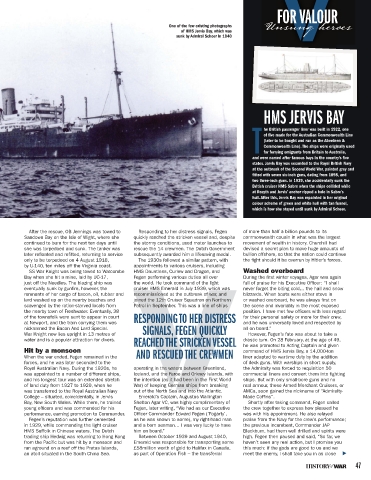
                                                                 One of the few existing photographs   Unsung heroes
                                                                     of HMS Jervis Bay, which was
                                                                   sunk by Admiral Scheer in 1940


                                                                                                  HMS JERVIS BAY


                                                                                                  he British passenger liner was built in 1922, one
                                                                                                  of five made for the Australian Commonwealth Line
                                                                                                  (later to be bought and run as the Aberdeen &
                                                                                                  Commonwealth Line). The ships were originally used
                                                                                              T for ferrying emigrants from Britain to Australia,
                                                                                              and were named after famous bays in the country’s five
                                                                                              states. Jervis Bay was seconded to the Royal British Navy
                                                                                              at the outbreak of the Second World War, painted grey and
                                                                                              fitted with seven six-inch guns, dating from 1898, and
                                                                                              two three-inch guns. In 1939, she accidentally sunk the
                                                                                              British cruiser HMS Sabre when the ships collided while
                                                                                              at Rosyth and Jervis’ anchor ripped a hole in Sabre’s
                                                                                              hull. After this, Jervis Bay was repainted in her original
                                                                                              colour scheme of green and white hull with tan funnel,
                                                                                              which is how she stayed until sunk by Admiral Scheer.


               After the rescue, OB Jennings was towed to   Responding to her distress signals, Fegen   of more than half a billion pounds to its
              Sandown Bay on the Isle of Wight, where she   quickly reached the stricken vessel and, despite   commonwealth cousin in what was the largest
              continued to burn for the next ten days until    the stormy conditions, used motor launches to   movement of wealth in history. Churchill had
              she was torpedoed and sunk. The tanker was   rescue the 14 crewmen. The Dutch Government   devised a secret plan to move huge amounts of
              later refloated and refitted, returning to service   subsequently awarded him a lifesaving medal.  bullion offshore, so that the nation could continue
              only to be torpedoed on 4 August 1918,    The 1930s followed a similar pattern, with   the fight should it be overrun by Hitler’s forces.
              by U-140, ten miles off the Virginia coast.  appointments to various cruisers, including
               SS War Knight was being towed to Watcombe   HMS Dauntless, Curlew and Dragon, and    Washed overboard
              Bay when she hit a mine, laid by UC-17,    Fegen performing various duties all over   During the first winter voyages, Agar was again
              just off the Needles. The blazing ship was   the world. He took command of the light   full of praise for his Executive Officer: “I shall
              eventually sunk by gunfire, however, the   cruiser HMS Emerald in July 1939, which was   never forget the biting cold… the hail and snow
              remnants of her cargo of bacon, oil, rubber and   recommissioned at the outbreak of war, and   blizzards. When boats were either stove in
              lard washed up on the nearby beaches and    joined the 12th Cruiser Squadron on Northern   or washed overboard, he was always first on
              scavenged by the ration-starved locals from   Patrol in September. This was a line of ships   the scene and invariably in the most exposed
              the nearby town of Freshwater. Eventually, 38                                position. I have met few officers with less regard
              of the townsfolk were sent to appear in court   RESPONDING TO HER DISTRESS   for their personal safety or more for their crew,
              at Newport, and the train carrying them was                                  and he was universally loved and respected by
              nicknamed the Bacon And Lard Special.    SIGNALS, FEGEN QUICKLY              all on board.”
              War Knight now lies upright in 13 metres of                                    However, Fegen’s fate was about to take a
              water and is a popular attraction for divers.  REACHED THE STRICKEN VESSEL   drastic turn. On 28 February, at the age of 49,
              Hit by a monsoon                       AND RESCUED THE CREWMEN               he was promoted to Acting Captain and given
                                                                                           command of HMS Jervis Bay, a 14,000-ton
              When the war ended, Fegen remained in the                                    liner adapted to wartime duty by the addition
              forces, and he was later seconded to the                                     of deck guns. With warships in short supply,
              Royal Australian Navy. During the 1920s, he   operating in the waters between Greenland,   the Admiralty was forced to requisition 50
              was appointed to a number of different ships,   Iceland, and the Faroe and Orkney Islands, with   commercial liners and convert them into fighting
              and his longest tour was an extended stretch   the intention (as it had been in the First World   ships. But with only small-bore guns and no
              of land duty from 1927 to 1929, when he   War) of keeping German ships from breaking    real armour, these Armed Merchant Cruisers, or
              was transferred to the Royal Australian Navy   out of the North Sea and into the Atlantic.  AMCs, soon gained the nickname of “Admiralty-
              College – situated, coincidentally, in Jervis   Emerald’s Captain, Augustus Wallington   Made Coffins”.
              Bay, New South Wales. While there, he trained   Shelton Agar VC, was highly complimentary of   Shortly after taking command, Fegen called
              young officers and was commended for his   Fegen, later writing, “We had as our Executive   the crew together to express how pleased he
              performance, earning promotion to Commander.  Officer Commander Edward Fegen (‘Fogarty’,    was with his appointment. He also relayed
               Fegen’s reputation was further cemented    as he was known to some), my right-hand man   praise from the Navy for the crew’s performance;
              in 1929, while commanding the light cruiser   and a born seaman… I was very lucky to have   the previous incumbent, Commander JAP
              HMS Suffolk in Chinese waters. The Dutch   him on board.”                    Blackburn, had them well drilled and spirits were
              trading ship Hedwig was returning to Hong Kong   Between October 1939 and August 1940,   high. Fegen then paused and said, “So far, we
              from the Pacific but was hit by a monsoon and   Emerald was responsible for transporting some   haven’t seen any real action, but I promise you
              ran aground on a reef off the Pratas Islands,    £58million worth of gold to Halifax in Canada,    this much: if the gods are good to us and we
              an atoll situated in the South China Sea.  as part of Operation Fish – the transferral   meet the enemy, I shall take you in as close
                                                                                                                 HISTORY  WAR    47
                                                                                                                         of

