


Page 49 - History of War - Issue 05-14
P. 49
FOR VALOUR
                                                                                                                        XXXXXX

                                                                                                   Unsung heroes
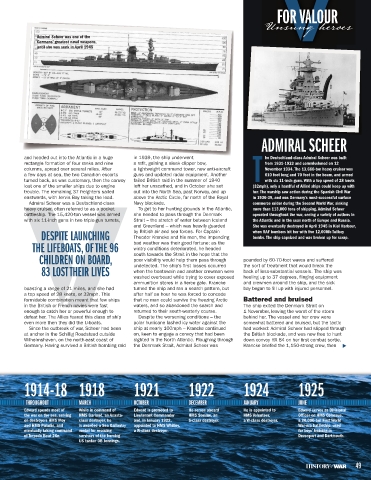
                  Admiral Scheer was one of the
                  Germans’ greatest naval weapons,
                  until she was sunk in April 1945


                                                                                                 ADMIRAL SCHEER


              and headed out into the Atlantic in a huge   in 1939, the ship underwent            he Deutschland-class Admiral Scheer was built
              rectangle formation of four ranks and nine   a refit, gaining a sleek clipper bow,    from 1931-1933 and commissioned on 12
              columns, spread over several miles. After    a lightweight command tower, new anti-aircraft   November 1934. The 13,660-ton heavy cruiser was
              a few days at sea, the two Canadian escorts   guns and updated radar equipment. Another   610 foot long and 70 foot in the beam, and armed
              turned back, as was customary, then the convoy   failed British raid in the summer of 1940   T with six 11-inch guns. With a top speed of 28 knots
              lost one of the smaller ships due to engine   left her unscathed, and in October she set    (32mph), only a handful of Allied ships could keep up with
              trouble. The remaining 37 freighters sailed   out into the North Sea, past Norway, and up   her. The warship saw action during the Spanish Civil War
              eastwards, with Jervis Bay taking the lead.  above the Arctic Circle, far north of the Royal   in 1936-39, and was Germany’s most-successful surface
               Admiral Scheer was a Deutschland-class   Navy blockade.                        commerce raider during the Second World War, sinking
              heavy cruiser, often referred to as a pocket   To get to her hunting grounds in the Atlantic,   more than 113,000 tons of shipping. Admiral Scheer
              battleship. The 15,420-ton vessel was armed   she needed to pass through the Denmark   operated throughout the war, seeing a variety of actions in
              with six 11-inch guns in two triple-gun turrets,   Strait – the stretch of water between Iceland   the Atlantic and in the seas north of Europe and Russia.
                                                    and Greenland – which was heavily guarded   She was eventually destroyed in April 1945 in Kiel Harbour,
                    DESPITE LAUNCHING               by British air and sea forces. For Captain   when RAF bombers hit her with five 12,000lb Tallboy
                                                    Theodor Krancke and his men, the impending
                                                                                              bombs. The ship capsized and was broken up for scrap.
                 THE LIFEBOATS, OF THE 96           bad weather was their good fortune: as the
                                                    wintry conditions deteriorated, he headed
                   CHILDREN ON BOARD,               south towards the Strait in the hope that the   pounded by 60-70-foot waves and suffered
                                                    poor visibility would help them pass through
                    83 LOST THEIR LIVES             undetected. The ship’s first losses occurred   the sort of treatment that would break the
                                                                                           back of less-substantial vessels. The ship was
                                                    when the boatswain and another crewman were
                                                    washed overboard while trying to cover exposed
                                                    ammunition stores in a fierce gale. Krancke   heeling up to 37 degrees, flinging equipment
                                                                                           and crewmen around the ship, and the sick
              boasting a range of 21 miles, and she had    turned the ship and ran a search pattern, but   bay began to fill up with injured personnel.
              a top speed of 28 knots, or 32mph. This   after half an hour he was forced to concede
              formidable combination meant that few ships    that no man could survive the freezing Arctic   Battered and bruised
              in the British or French navies were fast    waters, and so abandoned the search and   The ship exited the Denmark Strait on
              enough to catch her or powerful enough to   returned to their south-westerly course.  1 November, leaving the worst of the storm
              defeat her. The Allies feared this class of ship   Despite the worsening conditions – the    behind her. The vessel and her crew were
              even more then they did the U-boats.  polar hurricane lashed icy water against the    somewhat battered and bruised, but the tactic
               Since the outbreak of war, Scheer had been   ship at nearly 100mph – Krancke continued    had worked: Admiral Scheer had slipped through
              at anchor in the Schillig Roadstead outside   on, keen to engage a convoy that had been    the British blockade, and was now free to hunt
              Wilhelmshaven, on the north-east coast of   sighted in the North Atlantic. Ploughing through   down convoy HX 84 on her first combat sortie.
              Germany. Having survived a British bombing raid   the Denmark Strait, Admiral Scheer was   Krancke briefed the 1,150-strong crew, then


              1914-18  1918                         1921                1922               1924               1925


                THROUGHOUT       MARCH              OCTOBER             DECEMBER           JANUARY            JUNE
              Edward spends most of   While in command of    Edward is promoted to   He serves aboard    He is appointed to    Edward serves as Divisional
              the war on the sea, serving   HMS Garland, an Acasta-  Lieutenant Commander   HMS Somme, an    HMS Volunteer,    Officer on HMS Colossus,
              on destroyers HMS Moy   class destroyer, he    and, in January 1922,   S-class destroyer.  a W-class destroyer.  a 20,000-ton First World
              and HMS Paladin, and   is awarded a Sea Gallantry   appointed to HMS Whitley,                   War-era battleship, used
              eventually taking command   medal for rescuing   a W-class destroyer.                           for boys’ training in
              of Torpedo Boat 26e.    survivors of the burning                                                Devonport and Dartmouth.
                                 US tanker OB Jennings.


                                                                                                                 HISTORY  WAR    49
                                                                                                                         of

