


Page 52 - History of War - Issue 05-14
P. 52
Military M IL E ST O N E S
S WO R D S
SWORDS
The sword has been romanticised as the swashbuckler’s weapon
s w
eapon
ashbuckler’
the sw
The sword has been romanticised as
vastating swipe.
of choice, capable of maiming and murdering with one devastating swipe. vastating swipe.
capable of maiming and murdering with one de
capable of maiming and murdering with one de
,
,
t examines some of histor
t examines some of histor
s most impor
t examines some of histor
t examines some of histor
t examines some of histor
s most impor
tant examples
tant examples
s most impor
s most impor
s most impor
y’
Chris Short examines some of history’s most important examples
Chris Shor
Chris Shor
Chris Shor
Chris Short examines some of history’s most important examples
Chris Shor
y’
y’
y’
Chris Shor
Chris Shor t examines some of histor y’ s most impor tant examples
y’
tant examples
tant examples
tant examples
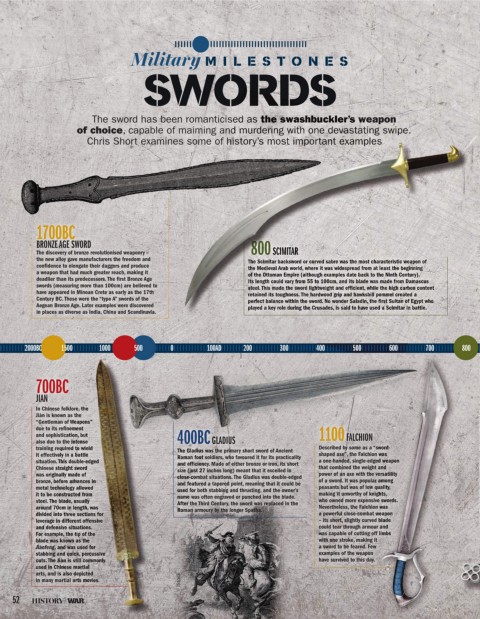
1700BC
0
BRONZE AGE SWORD 80 80 0
SCIMITAR
SCIMITAR
The discovery of bronze revolutionised weaponry – 800 SCIMITAR
the new alloy gave manufacturers the freedom and The Scimitar backsword or curved sabre was the most characteristic weapon of
as the most char
as the most char
The Scimitar backs
acteristic weapon of
ved sabre w
word or cur
acteristic weapon of
word or cur
The Scimitar backs
ved sabre w
confidence to elongate their daggers and produce the Mediev al Ar ab wor ld, where it w as widespread from at least the be ginning
Ar
ab wor
where it w
al
as widespread from at least the be
ld,
the Medieval Arab world, where it was widespread from at least the beginning
ginning
the Mediev
a weapon that had much greater reach, making it of the Ottoman Empire (although examples date back to the Ninth Century).
y).
of the Ottoman Empire (although examples date back to the Ninth Centur
y).
of the Ottoman Empire (although examples date back to the Ninth Centur
deadlier than its predecessors. The first Bronze Age Its length could v ar y from 55 to 100cm, and its blade w as made from Damascus
y from 55 to 100cm,
as made from Damascus
and its blade w
Its length could v
as made from Damascus
Its length could v
y from 55 to 100cm,
Its length could vary from 55 to 100cm, and its blade was made from Damascus
ar
ar
and its blade w
swords (measuring more than 100cm) are believed to steel. This made the s word lightweight and efficient, while the high carbon content
steel. This made the sword lightweight and efficient, while the high carbon content
steel.
steel.
word lightweight and efficient,
This made the s
This made the s
word lightweight and efficient,
while the high carbon content
while the high carbon content
have appeared in Minoan Crete as early as the 17th retained its toughness. The hardwood grip and hawksbill pommel created a
wksbill pommel created a
The hardwood g
The hardwood g
retained its toughness.
rip and ha
wksbill pommel created a
rip and ha
retained its toughness.
Century BC. These were the “type A” swords of the perfect balance within the s word. No wonder Saladin, the first Sultan of Eg ypt who
No wonder Saladin,
the first Sultan of Eg
ypt who
the first Sultan of Eg
word.
word.
perfect balance within the sword. No wonder Saladin, the first Sultan of Egypt who
No wonder Saladin,
perfect balance within the s
ypt who
perfect balance within the s
Aegean Bronze Age. Later examples were discovered pla yed a k ey role during the Cr usades, is said to ha ve used a Scimitar in battle.
pla
played a key role during the Crusades, is said to have used a Scimitar in battle.
is said to ha
usades,
ey role during the Cr
ey role during the Cr
usades,
yed a k
is said to ha
yed a k
ve used a Scimitar in battle.
ve used a Scimitar in battle.
pla
in places as diverse as India, China and Scandinavia.
600 600
500500
400
2000BC 1500 1000 500 0 100AD 200 300 400400 500 600 700 800
700BC
JIAN
In Chinese folklore, the
In Chinese folklore, the
Jiàn is known as the
Jiàn is known as the
“Gentleman of Weapons”
“Gentleman of W eapons”
due to its refinement
due to its refinement
C
0B
0B
0
C
0
but
and sophistication, but 4 4 4 0 0B C 1100 FALCHION
and sophistication,
GLADIUS
GLADIUS
also due to the intense 400BC GLADIUS
also due to the intense
y some as a
Described by some as a “sword-
“s
Described b
word-
training required to wield The Gladius was the primary short sword of Ancient Described b y some as a “s word-
tr
aining required to wield
The Gladius w
Ancient
word of
y shor
t s
as the primar
the F
as
shaped axe”, the Falchion was
alchion w
shaped axe”,
it effectively in a battle Roman foot soldiers, who fa voured it for its pr acticality shaped axe”, the F alchion w as
it effectively in a battle
Roman foot soldiers, who favoured it for its practicality
ed weapon
ed weapon
single-edg
single-edg
a one-handed,
a one-handed,
situation. This double-edged
situation.
This
double-edg
ed
situation. This double-edg ed and efficiency. Made of either bronze or iron, its short t a one-handed, single-edged weapon
Made of either bronze or iron,
.
and efficiency
its shor
that combined the weight and
word
Chinese str
aight s
Chinese straight sword size (just 27 inches long) meant that it excelled in that combined the weight and
size (just 27 inches long) meant that it excelled in
power of an axe with the versatility
power of an axe with the versatility
was originally made of close-combat situations. The Gladius w as double-edg ed power of an axe with the versatility
w
as originally made of
close-combat situations. The Gladius was double-edged
of a sword. It was popular among
bronze,
bronze, before advances in and featured a tapered point, meaning that it could be of a s word. It w as popular among
before adv
ances in
meaning that it could be
and featured a tapered point,
peasants but was of low quality,
metal technolog
metal technology allowed used for both stabbing and thr usting , and the owner’ s peasants but w as of low quality ,
y allowed
used for both stabbing and thrusting, and the owner’s
making it unworthy of knights,
it to be constructed from name was often engraved or punched into the blade. making it unwor th y of knights,
it to be constr
ucted from
r
name w
a
ved or punched into the blade.
as often eng
words.
who owned more expensive swords.
who owned more expensive s
steel. The blade, usually After the Third Century, the sword was replaced in the who owned more expensive s words.
steel. The blade, usually
y
y
,
,
After the
After the
Third Centur
Third Centur
as replaced in the
word w
word w
the s
the s
as replaced in the
Never
alchion w
as
theless,
the F
w
around 70cm in length, w as Roman armoury by the longer Spatha. Nevertheless, the Falchion was
as
around 70cm in length, was
around 70cm in length,
y the long
y b
y the long
er Spatha.
er Spatha.
Roman ar
Roman ar
mour
y b
mour
a powerful close-combat weapon
a powerful close-combat weapon
divided into three sections for
divided into three sections for
divided into three sections for a powerful close-combat weapon
– its short, slightly curved blade
slightly cur
ved blade
t,
– its shor
ag
lever
leverage in different offensive
lever ag e in different offensive – its shor t, slightly cur ved blade
e in different offensive
mour and
mour and
could tear through ar
could tear through ar
and defensive situations. could tear through armour and
and defensive situations.
as capable of cutting off limbs
as capable of cutting off limbs
F For example, the tip of the w w was capable of cutting off limbs
the tip of the
or example,
with one stroke, making it
blade was known as the
blade w as known as the with one strok e, making it
Jiànfeng, and was used for as used for
Jiànfeng , and w a sword to be feared. Few
cussive
stabbing and quick, per cussive examples of the weapon
per
stabbing and quick,
stabbing and quick, percussive
cuts.
The Jiàn is still commonly
The Jiàn is still commonly
cuts.
cuts. The Jiàn is still commonly have survived to this day.
used in Chinese mar tial
used in Chinese martial
ar ts, and is also depicted
arts, and is also depicted
y mar
tial ar
ts movies.
in man
in man y mar tial ar ts movies. iStock
in many martial arts movies.
52 HISTORY WAR
of

