


Page 53 - History of War - Issue 05-14
P. 53
0
0
16 16 0 0
1600 SCHIAVONA
vona w
word that
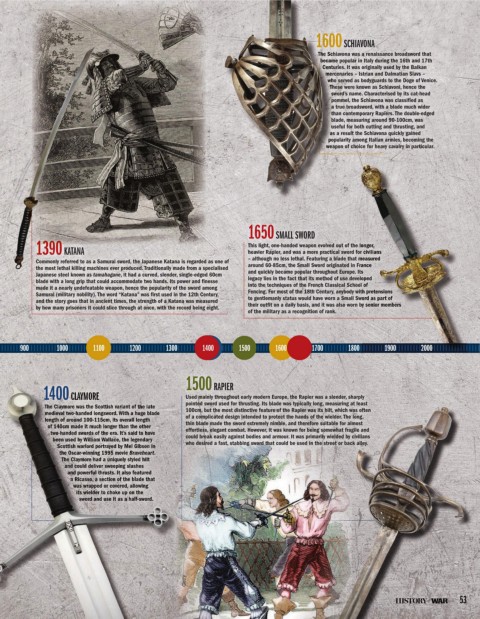
The Schiavona was a renaissance broadsword that
The Schia
as a renaissance broads
The Schia vona w as a renaissance broads word that
became popular in Italy during the 16th and 17th
became popular in Italy during the 16th and 17th
became popular in Italy during the 16th and 17th
y the Balkan
Centuries. It w as originally used b y the Balkan
Centuries. It was originally used by the Balkan
as originally used b
Centuries.
It w
mer cenaries – Istrian and Dalmatian Sla vs –
mercenaries – Istrian and Dalmatian Slavs –
who served as bodyguards to the Doge of Venice.
ved as bodyguards to the Dog
enice.
who ser
V
e of
These were known as Schiavoni, hence the
These were known as Schia
voni,
hence the
Char
word’
s
sword’s name. Characterised by its cat-head
s name.
acterised b
y its cat-head
pommel,
as classified as
pommel, the Schiavona was classified as
the Schia
vona w
ue broads
a true broadsword, with a blade much wider
a tr
with a blade much wider
word,
y Rapiers.
than contemporary Rapiers. The double-edged
than contempor
ar
The double-edg
ed
measuring around 90-100cm,
w
as
blade,
blade, measuring around 90-100cm, was
useful for both cutting and thrusting, and
useful for both cutting and thr usting , and
as a result the Schiavona quickly gained
vona quickly g
ained
as a result the Schia
popularity among Italian armies, becoming the
mies,
becoming the
popularity among Italian ar
alr
.
v
weapon of choice for heavy cavalry in particular.
ticular
y in par
weapon of choice for hea
vy ca
1650 SMALL SWORD
0
1 1 1 39 0 This light, one-handed weapon evolved out of the long er , ,
39
39
0
one-handed weapon evolved out of the long
This light,
er
This light, one-handed weapon evolved out of the longer,
1390 KATANA
,
and w
,
vier Rapier
vier Rapier
and w
actical s
word for civilians
word for civilians
as a more pr
as a more pr
actical s
hea
hea
heavier Rapier, and was a more practical sword for civilians
F
– although no less lethal.
– although no less lethal.
eaturing a blade that measured
eaturing a blade that measured
F
Commonly referred to as a Samurai sword, the Japanese Katana is regarded as one of – although no less lethal. Featuring a blade that measured
the Small Sword originated in Fr
around 60-85cm,
ance
ance
the Small Sword originated in Fr
around 60-85cm,
the most lethal killing machines ever produced. Traditionally made from a specialised around 60-85cm, the Small Sword originated in France
and quickly became popular throughout Europe. Its
Its
and quickly became popular throughout Europe.
Japanese steel known as tamahagane, it had a curved, slender, single-edged 60cm and quickly became popular throughout Europe. Its
g
le le
acy lies in the fact that its method of use developed
acy lies in the fact that its method of use developed
g
blade with a long grip that could accommodate two hands. Its power and finesse legacy lies in the fact that its method of use developed
into the techniques of the French Classical School of
into the techniques of the French Classical School of
made it a nearly undefeatable weapon, hence the popularity of the sword among into the techniques of the French Classical School of
.
F
F
.
ybody with pretensions
y
,
,
an
an
y
or most of the 18th Centur
encing
or most of the 18th Centur
encing
ybody with pretensions
F F
Samurai (military nobility). The word “Katana” was first used in the 12th Century, Fencing. For most of the 18th Century, anybody with pretensions
entlemanly status would ha
to g
t of
ve wor
to gentlemanly status would have worn a Small Sword as part of
n a Small Sword as par
and the story goes that in ancient times, the strength of a Katana was measured to g entlemanly status would ha ve wor n a Small Sword as par t of
their outfit on a daily basis, and it was also worn by senior members
and it w
as also wor
their outfit on a daily basis,
n b
y senior members
by how many prisoners it could slice through at once, with the record being eight. their outfit on a daily basis, and it w as also wor n b y senior members
of the military as a recognition of rank.
800 900 1000 1100 1200 1300 1400 1500 1600 1700 1800 1900 2000
20002000
19001900
14 14 0 0 CLA YMORE 1500 RAPIER
0
0
1400 CLAYMORE
Used mainly throughout early modern Europe, the Rapier was a slender, sharply
The Claymore was the Scottish variant of the late pointed sword used for thrusting. Its blade was typically long, measuring at least
as the Scottish v
ariant of the late
ymore w
The Cla
medieval two-handed longsword. With a huge blade
mediev al two-handed longs word. W ith a hug e blade 100cm, but the most distinctive feature of the Rapier was its hilt, which was often
length of around 100-115cm, its overall length of a complicated design intended to protect the hands of the wielder. The long,
length of around 100-115cm,
all length
its over
of 140cm made it much longer than the other
of 140cm made it much long er than the other thin blade made the sword extremely nimble, and therefore suitable for almost
It’
a.
ve
s said to ha
words of the er
two-handed s
two-handed swords of the era. It’s said to have effortless, elegant combat. However, it was known for being somewhat fragile and
been used b
been used by William Wallace, the legendary could break easily against bodies and armour. It was primarily wielded by civilians
illiam
W
y
W
allace,
endar
y
the le
g
lord por
Scottish w
ar
Scottish warlord portrayed by Mel Gibson in who desired a fast, stabbing sword that could be used in the street or back alley.
yed b
y Mel Gibson in
tr
a
the Oscar-winning 1995 movie Brav ehear t
the Oscar-winning 1995 movie Braveheart. .
The Cla ymore had a uniquely styled hilt
The Claymore had a uniquely styled hilt
and could deliver sweeping slashes
and could deliver s weeping slashes
and powerful thrusts. It also featured
and powerful thr usts. It also featured
a Ricasso, a section of the blade that
a Ricasso, a section of the blade that
w as wr apped or covered, allowing
was wrapped or covered, allowing
its wielder to chok e up on the
its wielder to choke up on the
word and use it as a half-s
word.
s sword and use it as a half-sword.
Getty
HISTORY WAR 53 53
HISTORY WAR
Y
Y
ISTO
Y
R
R
R
H H H
ISTO
ISTO
of of of

