


Page 71 - History of War - Issue 05-14
P. 71
The wounded would have to stay where they
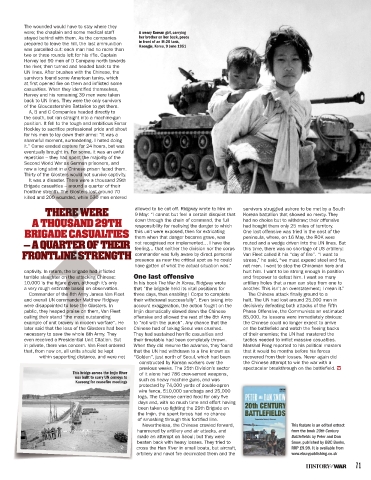
              were; the chaplain and some medical staff   A weary Korean girl, carrying
              stayed behind with them. As the companies   her brother on her back, poses
              prepared to leave the hill, the last ammunition   in front of an M-26 tank,
                                                      Haengju, Korea, 9 June 1951
              was parcelled out: each man had no more than
              two or three rounds left for his rifle. Captain
              Harvey led 90 men of D Company north towards
              the river, then turned and headed back to the
              UN lines. After brushes with the Chinese, the
              survivors found some American tanks, which
              at first opened fire on them and inflicted some
              casualties. When they identified themselves,
              Harvey and his remaining 39 men were taken
              back to UN lines. They were the only survivors
              of the Gloucestershire Battalion to get there.
               A, B and C Companies headed directly to
              the south, but ran straight into a machine-gun
              position. It fell to the tough and ambitious Farrar
              Hockley to sacrifice professional pride and shout
              for his men to lay down their arms: “It was a
              for his men to lay down their arms: “It was a
              shameful moment, surrendering. I hated doing
              shameful moment, surrendering. I hated doing
              it.” Carne evaded capture for 24 hours, but was
              it.” Carne evaded capture for 24 hours, but was
              eventually brought in. For some, it was an awful
              eventually brought in. For some, it was an awful
              repetition – they had spent the majority of the
              repetition – they had spent the majority of the
              Second World War as German prisoners, and
              Second World War as German prisoners, and
              now a long stint in a Chinese prison faced them.
              now a long stint in a Chinese prison faced them.
              Thirty of the Glosters would not survive captivity.
              Thirty of the Glosters would not survive captivity.
               It was a disaster. There were a thousand 29th
               It was a disaster. There were a thousand 29th
              Brigade casualties – around a quarter of their
              Brigade casualties – around a quarter of their
              frontline strenth. The Glosters lost around 70
              frontline strenth. The Glosters lost around 70
              killed and 200 wounded, while 530 men entered
              killed and 200 wounded, while 530 men entered
                     THERE WERE
                     THERE WERE                      allowed to be cut off. Ridgway wrote to him on   survivors struggled ashore to be met by a South
                                                     9 May: “I cannot but feel a certain disquiet that
                                                                                           Korean battalion that showed no mercy. They
                A THOUSAND 29TH
                A THOUS        AND 29TH              down through the chain of command, the full   had no choice but to withdraw; their offensive
                                                     responsibility for realising the danger to which
                                                                                           had bought them only 25 miles of territory.
              BRIGADE CASUALTIES                     this unit were exposed, then for extricating   One last offensive was tried in the east of the
                                                     them when that danger became grave, was
                                                                                           peninsula, where, on 16 May, the ROK were
              – A QUARTER OF THEIR
              – A QU    AR  TER OF THEIR              not recognised nor implemented… I have the   routed and a wedge driven into the UN lines. But
                                                     feeling… that neither the division nor the corps
                                                                                           this time, there was no shortage of US artillery:
             FR
             FRONTLINE STRENGTH                      commander was fully aware by direct personal   Van Fleet called it his “day of fire”. “I want to
                                        E
                                     R
                                            G
                                          N
                                   T
                                                 H
                 ONTLINE S
                                               T
                                                     presence as near the critical spot as he could
                                                                                           stress,” he said, “we must expend steel and fire,
                                                     have gotten of what the actual situation was.”  not men. I want to stop the Chinaman here and
              captivity. In return, the brigade had inflicted                               hurt him. I want to be strong enough in position
              captivity. In return, the brigade had inflicted
              terrible slaughter on the attacking Chinese:
              terrible slaughter on the attacking Chinese:   One last offensive            and firepower to defeat him. I want so many
              10,000 is the figure given, although it’s only    In his book The War In Korea, Ridgway wrote    artillery holes that a man can step from one to
              10,000 is the figure given, although it’s only
              a very rough estimate based on observation.
              a very rough estimate based on observation.  that “the brigade held its vital positions for   another. This isn’t an overstatement; I mean it.”
               Commander of the 8th Army James Van Fleet   three days, thus enabling I Corps to complete   The Chinese attack finally ground to a
               Commander of the 8th Army James Van Fleet
              and overall UN commander Matthew Ridgway
              and overall UN commander Matthew Ridgway   their withdrawal successfully”. Even taking into   halt. The UN had lost around 25,000 men in
              were disappointed to lose the Glosters. In
              were disappointed to lose the Glosters. In   account exaggeration, the action fought on the   decisively defeating both attacks of the Fifth
              public, they heaped praise on them, Van Fleet
              public, they heaped praise on them, Van Fleet   Imjin dramatically slowed down the Chinese   Phase Offensive, the Communists an estimated
              calling their stand “the most outstanding   offensive and allowed the rest of the 8th Army   85,000. Its lessons were immediately obvious:
              calling their stand “the most outstanding
              example of unit bravery in modern warfare”. He   to “roll with the punch”. Any chance that the   the Chinese could no longer expect to arrive
              example of unit bravery in modern warfare”. He
              later said that the loss of the Glosters had been
              later said that the loss of the Glosters had been   Chinese had of taking Seoul was crushed.   on the battlefield and watch the fleeing backs
              necessary to save the whole 8th Army. They   They had sustained horrific casualties and   of their enemies; the UN had mastered the
              even received a Presidential Unit Citation. But   their timetable had been completely thrown.   tactics needed to inflict massive casualties.
              in private, there was concern. Van Fleet ordered   When they did resume the advance, they found   Marshal Peng reported to his political masters
              that, from now on, all units should be kept   that the UN had withdrawn to a line known as   that it would be months before his forces
                   within supporting distance, and were not   “Golden”, just north of Seoul, which had been   recovered from their losses. Never again did
                                                      constructed by Korean workers over the   the Chinese attempt to win the war with a
                                                      previous weeks. The 25th Division’s sector    spectacular breakthrough on the battlefield. w
                               This bridge across the Imjin River     of it alone had 786 crew-served weapons,
                                was built to carry UN convoys to     such as heavy machine guns, and was
                                Kaesong for ceasefire meetings
                                                      protected by 74,000 yards of double-apron
                                                      wire fence, 510,000 sandbags and 25,000
                                                      logs. The Chinese carried food for only five
                                                      days and, with so much time and effort having
                                                      been taken up fighting the 29th Brigade on
                                                      the Imjin, the spent forces had no chance
                                                      of smashing through this fortified line.
                                                       Nevertheless, the Chinese crawled forward,           This feature is an edited extract
                                                     hammered by artillery and air attacks, and             from the book 20th Century
                                                     made an attempt on Seoul; but they were                Battlefields by Peter and Dan
                                                     beaten back with heavy losses. They tried to           Snow, published by BBC Books,
                                                 AP  cross the Han River in small boats, but aircraft,      RRP £9.99. It is available from
                                                     artillery and naval fire decimated them and the         www.eburypublishing.co.uk
                                                                                                                 HISTORY  WAR    71
                                                                                                                         of

