


Page 76 - History of War - Issue 05-14
P. 76
RECONSTRUCTING D-DAY


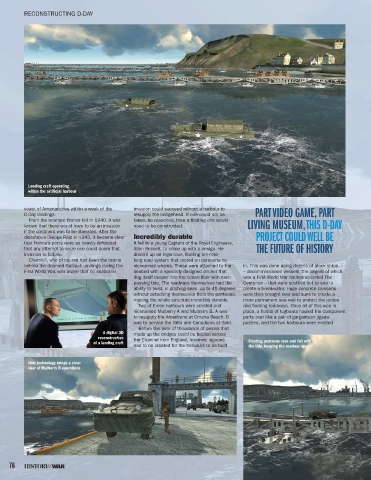
               Landing craft operating
               within the artificial harbour


              coast of Arromanches within a week of the    invasion could succeed without a harbour to   PART VIDEO GAME, PART
              D-Day landings.                       resupply the bridgehead. If one could not be
               From the moment France fell in 1940, it was   taken, he reasoned, then a floating one would
              known that there would have to be an invasion   need to be constructed.       LIVING MUSEUM, THIS D-DAY
              if the continent was to be liberated. After the
              disastrous Dieppe Raid in 1942, it became clear   Incredibly durable             PROJECT COULD WELL BE
              that France’s ports were so heavily defended   It fell to a young Captain of the Royal Engineers,
              that any attempt to seize one could doom that   Allan Beckett, to come up with a design. He   THE FUTURE OF HISTORY
              invasion to failure.                  dreamt up an ingenious, floating ten-mile-
               Churchill, who of course had been the brains   long road system that rested on pontoons he
              behind the doomed Gallipoli landings during the   nicknamed whales. These were attached to the   in. This was done using dozens of block ships
              First World War, was aware that no seaborne   seabed with a specially designed anchor that   – decommissioned vessels, the largest of which
                                                    dug itself deeper into the ocean floor with each   was a First World War battleship called The
                                                    passing tide. The roadways themselves had the   Centurion – that were scuttled out to sea to
                                                    ability to twist, in pitching seas, up to 45 degrees   create a breakwater. Huge concrete caissons
                                                    without detaching themselves from the pontoons,   were then brought over and sunk to create a
                                                    making the whole structure incredibly durable.  more permanent sea wall to protect the jetties
                                                      Two of these harbours were created and   and floating roadways. Once all of this was in
                                                    nicknamed Mulberry A and Mulberry B. A was    place, a flotilla of tugboats hauled the component
                                                    to resupply the Americans at Omaha Beach, B   parts over like a pair of gargantuan jigsaw
                                                    was to service the Brits and Canadians at Gold.   puzzles, and the two harbours were erected
                                                      Before the tens of thousands of pieces that
                                         A digital 3D     made up the bridges could be hauled across
                                        reconstruction     the Channel from England, however, lagoons
                                      of a landing craft                                     Floating pontoons rose and fell with
                                                    had to be created for the harbours to be built   the tide, keeping the roadway open


               New technology brings a clear
               view of Mulberry B operations


                                                                                        Mary Evans


        76    HISTORY  WAR
                      of

