


Page 75 - History of War - Issue 05-14
P. 75
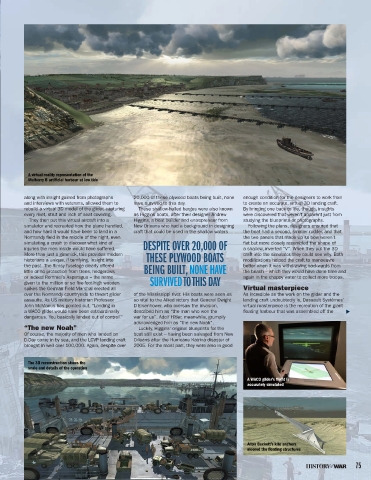
A virtual-reality representation of the
               Mulberry B artificial harbour at low tide

              along with insight gained from photographs    20,000 of these plywood boats being built, none   enough condition for the designers to work from
              and interviews with veterans, allowed them to   have survived to this day.   to create an accurate, virtual 3D landing craft.
              rebuild a virtual 3D model of the glider, capturing   These shallow-hulled barges were also known   By bringing one back to life, though, insights
              every rivet, strut and inch of seat covering.   as Higgins boats, after their designer Andrew   were discovered that weren’t apparent just from
               They then put this virtual aircraft into a   Higgins, a boat builder and entrepreneur from   studying the blueprints or photographs.
              simulator and recreated how the plane handled,   New Orleans who had a background in designing   Following the plans, designers ensured that
              and how hard it would have been to land in a   craft that could be used in the shallow waters    the boat had a second, smaller rudder, and that
              Normandy field in the middle of the night, even                               the two panels that made up its bow weren’t
              simulating a crash to discover what kind of   DESPITE OVER 20,000 OF         flat but more closely resembled the shape of
              injuries the men inside would have suffered.                                 a shallow, inverted “V”. When they put the 3D
              More than just a gimmick, this provides modern   THESE PLYWOOD BOATS         craft into the simulator, they could see why. Both
              historians a unique, if terrifying, insight into                             modifications helped the craft to manoeuvre
              the past. The flimsy fuselage clearly offered    BEING BUILT, NONE HAVE       better when it was withdrawing backwards from
              little or no protection from trees, hedgerows                                the beach – which they would have done time and
              or indeed Rommel’s Asparagus – the name     SURVIVED TO THIS DAY             again in the choppy water to collect more troops.
              given to the million or so five-foot-high wooden
              spikes the German Field Marshal erected all                                  Virtual masterpiece
              over the Normandy countryside to thwart glider   of the Mississippi river. His boats were seen as   As incredible as the work on the glider and the
              assaults. As US military historian Professor    so vital to the Allied victory that General Dwight    landing craft undoubtedly is, Dassault Systèmes’
              John McManus has pointed out, “Landing in    D Eisenhower, who oversaw the invasion,   virtual masterpiece is the recreation of the giant
              a WACO glider would have been extraordinarily   described him as “the man who won the   floating harbour that was assembled off the
              dangerous. You basically landed out of control!”   war for us”. Adolf Hitler, meanwhile, grumpily
                                                    acknowledged him as “the new Noah”.
              “The new Noah”                          Luckily, Higgins’ original blueprints for the
              Of course, the majority of men who landed on   boat still exist – having been salvaged from New
              D-Day came in by sea, and the LCVP landing craft   Orleans after the Hurricane Katrina disaster of
              brought in well over 100,000. Again, despite over   2005. For the most part, they were also in good


               The 3D reconstruction shows the
               scale and details of the operation
                                                                                            A WACO glider’s flight is
                                                                                            accurately simulated


                                                                                            Allan Beckett’s kite anchors
                                                                                            moored the floating structures

                                                                                                                 HISTORY  WAR    75
                                                                                                                         of

