


Page 22 - The Dinosaur Book and Other Wonders of the Prehistoric World (DK-Smithsonian)
P. 22
Evolution and


       Introduction  extinction


           Fossils reveal how life has changed over time. This
           was not fully understood until the 19th century, when
           fossils became important evidence supporting the
           theory of evolution by natural selection. Developed
           primarily by English scientist Charles Darwin, this

           theory showed that the individuals in a species vary
           in their ability to cope with the hardships of life—
           some survive and breed, while others do not. As a
           result, species gradually change over time as they
           adapt to the changing world. New species evolve, and
           older ones may die out completely, becoming extinct.


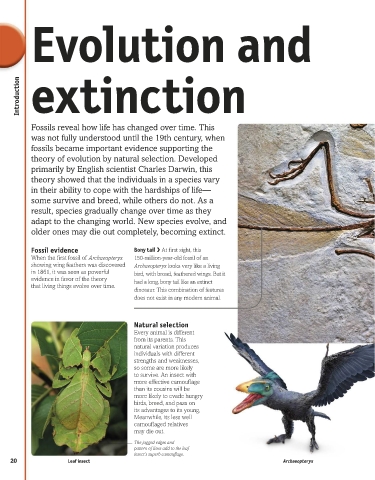
           Fossil evidence                   Bony tail ❯ At first sight, this
           When the first fossil of Archaeopteryx   150-million-year-old fossil of an
           showing wing feathers was discovered   Archaeopteryx looks very like a living
           in 1861, it was seen as powerful   bird, with broad, feathered wings. But it
           evidence in favor of the theory    had a long, bony tail like an extinct
           that living things evolve over time.
                                             dinosaur. This combination of features
                                             does not exist in any modern animal.


                                             Natural selection
                                             Every animal is different
                                             from its parents. This
                                             natural variation produces
                                             individuals with different
                                             strengths and weaknesses,
                                             so some are more likely
                                             to survive. An insect with
                                             more effective camouflage
                                             than its cousins will be
                                             more likely to evade hungry
                                             birds, breed, and pass on
                                             its advantages to its young,
                                             Meanwhile, its less well
                                             camouflaged relatives
                                             may die out.

                                             The jagged edges and
                                             pattern of lines add to the leaf
                                             insect’s superb camouflage.
    20                 Leaf insect                                                           Archaeopteryx


   US_020-021_Evolution_and_Extinction.indd   20                                                                 10/04/18   3:32 PM

