


Page 23 - The Dinosaur Book and Other Wonders of the Prehistoric World (DK-Smithsonian)
P. 23
New species
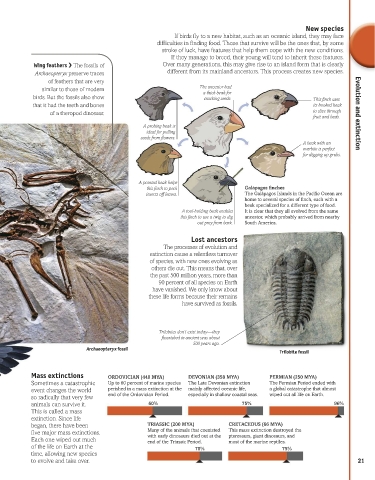
                                                          If birds fly to a new habitat, such as an oceanic island, they may face
                                                    difficulties in finding food. Those that survive will be the ones that, by some
                                                      stroke of luck, have features that help them cope with the new conditions.
                                                         If they manage to breed, their young will tend to inherit these features.
            Wing feathers ❯ The fossils of            Over many generations, this may give rise to an island form that is clearly
            Archaeopteryx preserve traces               different from its mainland ancestors. This process creates new species.
                 of feathers that are very
               similar to those of modern                         The ancestor had
                                                                   a thick beak for
            birds. But the fossils also show                        cracking seeds.                    This finch uses
            that it had the teeth and bones                                                            its hooked beak
                 of a theropod dinosaur.                                                               to slice through   Evolution and extinction
                                                                                                       fruit and buds.
                                                A probing beak is
                                                 ideal for pulling
                                               seeds from flowers.
                                                                                                    A beak with an
                                                                                                    overbite is perfect
                                                                                                    for digging up grubs.


                                              A pointed beak helps
                                                 this finch to peck              Galápagos finches
                                                 insects off leaves.             The Galápagos Islands in the Pacific Ocean are
                                                                                 home to several species of finch, each with a
                                                                                 beak specialized for a different type of food.
                                                            A tool-holding beak enables   It is clear that they all evolved from the same
                                                            this finch to use a twig to dig   ancestor, which probably arrived from nearby
                                                                 out prey from bark.  South America.

                                                               Lost ancestors
                                                      The processes of evolution and
                                                  extinction cause a relentless turnover
                                                  of species, with new ones evolving as
                                                  others die out. This means that, over
                                                  the past 500 million years, more than
                                                     90 percent of all species on Earth
                                                   have vanished. We only know about
                                                  these life forms because their remains
                                                            have survived as fossils.


                                                     Trilobites don’t exist today—they
                                                      flourished in ancient seas about
                                                                500 years ago.
                             Archaeopteryx fossil
                                                                                            Trilobite fossil


           Mass extinctions         ORDOVICIAN (440 MYA)       DEVONIAN (358 MYA)        PERMIAN (250 MYA)
           Sometimes a catastrophic   Up to 60 percent of marine species   The Late Devonian extinction   The Permian Period ended with
           event changes the world    perished in a mass extinction at the   mainly affected oceanic life,   a global catastrophe that almost
           so radically that very few   end of the Ordovician Period.  especially in shallow coastal seas.  wiped out all life on Earth.
           animals can survive it.                60%                           75%                           96%
           This is called a mass
           extinction. Since life
           began, there have been                TRIASSIC (200 MYA)         CRETACEOUS (66 MYA)
           five major mass extinctions.          Many of the animals that coexisted   This mass extinction destroyed the
                                                                            pterosaurs, giant dinosaurs, and
           Each one wiped out much               with early dinosaurs died out at the   most of the marine reptiles.
                                                 end of the Triassic Period.
           of the life on Earth at the                           70%                         75%
           time, allowing new species
           to evolve and take over.                                                                                   21


   US_020-021_Evolution_and_Extinction.indd   21                                                                 10/04/18   3:32 PM

