


Page 72 - Complete Birds of Britain and Europe (DK - RSPB)
P. 72
GANNETS, CORMORANTS,AND PELICANS
        Families Sulidae, Phalacrocoracidae, Pelicanidae
        GANNETS, CORMORANTS,
        AND PELICANS


          T FIRST SIGHT A MIXED bunch, this group  CORMORANTS
        Aof water birds shares several characteristics,  The Cormorant is a generalist,
        including a long inner wing with an obvious,  able to feed in the open sea,
        backward-pointed “elbow” joint near the body,  in quiet estuaries, and in
        and broad webbing across all four toes (wildfowl  lakes or rivers. It nests in
        have webs only between the front three).They  trees, as well as on cliffs.
        all feed on fish, some being restricted to the sea,  The Shag nests only
        others coming inland too.        on cliffs and feeds in
                                         saltwater.The Pygmy
        GANNETS                          Cormorant is a freshwater
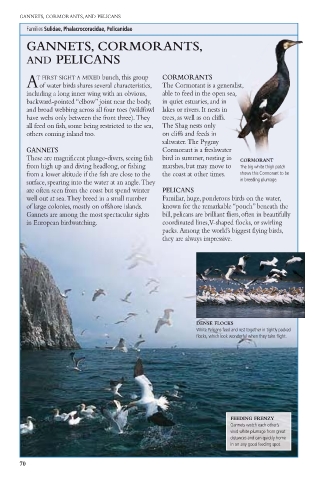
        These are magnificent plunge-divers, seeing fish  bird in summer, nesting in  CORMORANT
        from high up and diving headlong, or fishing  marshes, but may move to  The big white thigh patch
        from a lower altitude if the fish are close to the  the coast at other times.  shows this Cormorant to be
        surface, spearing into the water at an angle.They    in breeding plumage.
        are often seen from the coast but spend winter  PELICANS
        well out at sea.They breed in a small number   Familiar, huge, ponderous birds on the water,
        of large colonies, mostly on offshore islands.  known for the remarkable “pouch” beneath the
        Gannets are among the most spectacular sights  bill,pelicans are brilliant fliers,often in beautifully
        in European birdwatching.        coordinated lines,V-shaped flocks, or swirling
                                         packs. Among the world’s biggest flying birds,
                                         they are always impressive.


                                                  DENSE FLOCKS
                                                  White Pelicans feed and rest together in tightly packed
                                                  flocks, which look wonderful when they take flight.


                                                          FEEDING FRENZY
                                                          Gannets watch each other’s
                                                          vivid white plumage from great
                                                          distances and can quickly home
                                                          in on any good feeding spot.

      70

